


Are Travel Pillows Worth It? An Honest Answer (2026)
Are travel pillows worth it? Honest answer: it depends entirely on which pillow. Independent testers keep reaching the same verdict — cheap, floppy U-pillows aren't worth the seat space, while properly supportive ones genuinely improve sleep on longer flights. Our own editorial rule of thumb: from about three hours in the air, a supportive pillow earns its place — provided it doesn't cost you packing space. Ours stores a full change of clothes, so it never does.
- Cheap floppy U-pillows: no. Supportive ones on longer flights: yes.
- Our rule of thumb: worth it from about 3 hours in the air.
- Ours stores a change of clothes — zero net packing space.
- Dual-zipper clothes storage
- Holds its U-shape all flight
- 4.6/5 · 266 reviews
- Free in the 3-piece bundle
Compression Neck Pillow
€29.99
Free shipping across the EU
Are Travel Pillows Worth It? The Honest 2026 Verdict
Are travel pillows worth it? The short answer
Most travel pillows are worth it on longer flights — provided they actually support your neck. That's the consistent verdict across independent 2026 tests, which keep landing on the same split: cheap, hollow, floppy U-pillows do next to nothing and get abandoned in seat-back pockets worldwide, while firm, well-shaped pillows measurably improve how you sleep sitting up. Nobody credible claims every travel pillow is a scam, and nobody credible claims any old pillow will do.
So where's the cutoff? Here's our editorial rule of thumb — ours, not an industry standard: from about three hours in the air, a supportive travel pillow earns its place. Under that, you can tough it out with a rolled-up hoodie. Over it, your neck starts writing cheques your first holiday morning has to cash.
One condition, though, and it's the one most verdicts skip: the pillow has to earn its packing space too. On a budget-airline fare where your entire luggage is one 40 × 30 × 20 cm bag, a bulky pillow that carries nothing is a hard sell — which is exactly the problem we built ours to solve.
- Consensus of 2026 tests: supportive pillows yes on longer flights; cheap floppy ones no.
- Our editorial rule of thumb: worth it from about 3 hours in the air.
- Condition: it must not cost you packing space.
Do travel pillows work? What a good one actually does
Yes — travel pillows work, but only the supportive ones, and only because of basic mechanics. Your head is heavier than it has any right to be, and the moment you fall asleep upright, your neck muscles clock off and it drops sideways or forward. That head-bob wake-up cycle is why people "sleep" four hours and land exhausted anyway. A pillow that genuinely works interrupts the cycle: it fills the gap between your jaw and shoulder, holds your head close to neutral, and keeps doing it at hour three exactly as it did at minute five.
That last part is the real test. Reviewers who test pillows on actual flights consistently put shape retention and firm support at the top of what separates the winners from the seat-back-pocket casualties. The pillows that fail are the ones that flatten: soft hollow fibre-fill collapses under a sleeping head, and you're right back in bobble-head territory.
Ours passes that test for an unusual reason: it's filled with your own rolled change of clothes behind a dual-zipper compression layer. Packed clothes are firm by nature, so the pillow holds its U-shape the whole flight — no sag, no slow deflation, no mid-flight renegotiation.
- A good pillow stops the head-bob wake-up cycle.
- The real test is hour three: shape retention + firm support.
- Ours is firm by construction — rolled clothes inside, U-shape all flight.
When a travel pillow isn't worth it
A travel pillow isn't worth it in three cases: when it's a cheap hollow one, when the flight is short, and when it steals space you don't have. The floppy airport-kiosk U-pillow fails the only job it has — it flattens within the hour, your head keels over anyway, and you've paid for the privilege of carrying it through three terminals. Independent testers keep reaching the same conclusion, which is why none of them recommend the bargain bin.
Short hops are the second case. By our own three-hour rule of thumb, a 55-minute leg doesn't need specialist neck equipment. Save the space, drink the tiny coffee, land slightly crumpled.
The third case is the tricky one. On Ryanair or Wizz Air, the free personal bag measures 40 × 30 × 20 cm as of July 2026 — and on a basic fare, that bag is your entire luggage. A standard memory-foam pillow can swallow a noticeable chunk of it; clip one outside the bag instead and you're escorting a dangling croissant across Europe. If a pillow costs you a packed outfit, the maths stops working — unless the pillow IS the packed outfit. More on that below.
- Cheap hollow U-pillows flatten within the hour — skip them.
- Under ~3 hours in the air: tough it out.
- On a 40 × 30 × 20 personal-item fare, a bulky pillow costs you an outfit.
Memory Foam vs Inflatable Travel Pillow — and the Third Option
Every honest 2026 comparison boils down to support versus space: memory foam sleeps better, inflatables pack smaller. Here's the type-by-type verdict — plus the option most round-ups haven't met yet.
Memory foam: best support, worst bulk
The reviewers' pick for pure support: dense foam holds your head near neutral and keeps its shape for hours. The cost is bulk — it's often the single biggest item in a small bag, and on a 40 × 30 × 20 personal-item fare, that bulk is expensive real estate.
- Best pure support, keeps its shape for hours.
- Worst bulk — expensive on a 40 × 30 × 20 fare.
Inflatable: packs tiny, sleeps wobbly
Packs down to almost nothing, which is why backpackers tolerate one. But air chambers wobble under a sleeping head, firmness is a fiddly valve negotiation, and one puncture ends the relationship. Testers consistently rank them below foam for actual sleep.
- Packs tiny — great for space.
- Wobbles, fiddly valves, punctures — worse for actual sleep.
Storage pillow: foam-like support, zero net space
Our third way: a pillow filled with your own rolled change of clothes. Packed clothes are firm, so you get shaped, foam-like support — and because it carries garments that would otherwise sit in your bag, its net packing cost is zero. Support like foam, space bill like nothing.
- Rolled clothes inside = firm, shaped support.
- Net packing space used: zero.
The pillow that settles the argument
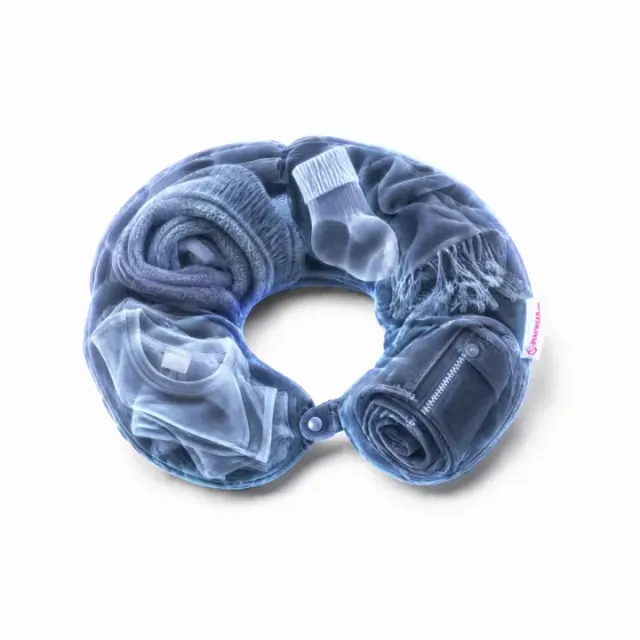
Pack a backup outfit
Open the inner pocket and tuck a full change of clothes into the empty neck pillow. Fold them flat so they nestle in nice and disappear inside.
How to Pick a Travel Pillow That Earns Its Place
Is a neck pillow worth it for long flights?
For long flights, yes — a supportive neck pillow is one of the highest-value things you can bring on board. Past our three-hour rule of thumb, and certainly on a five-plus-hour leg, the difference between landing human and landing wrecked mostly comes down to whether you actually slept — and an economy headrest was designed by someone who clearly never has. A firm, well-shaped pillow turns that seat into something you can genuinely sleep in, which is why long-haul testing keeps rewarding the supportive designs and punishing the soft ones.
The word "supportive" is doing all the work in that sentence. On a long flight, a pillow that collapses at hour two is worse than useless: it lulled you into a bad position and then abandoned you there. Look for shape retention above everything else.
And because long flights so often mean budget multi-leg itineraries on personal-item-only fares, weigh the space bill too. A pillow you'll lean on for eight hours and that carries a day's outfit inside it wins that calculation before the fancier foam even boards.
- Yes — past ~3 hours, sleep quality decides how you land.
- Shape retention matters more than plushness.
- On budget itineraries, weigh the packing-space bill too.
The space objection, solved: a pillow that stores your clothes
The classic knock on travel pillows — they waste precious hand-luggage space — disappears when the pillow IS the luggage. Our Compression Neck Pillow has a dual-zipper design: open the inner pocket, tuck in a full change of clothes folded flat, run the inner zip closed, then ease the outer compression zip along its track. The pillow puffs up plump, holds a proper U-shape, and now contains the outfit that would otherwise be occupying your 40 × 30 × 20 bag. Net packing space used: zero. Arguably negative.
And a pillow riding around your neck is a pillow, not a bag — it's recognised at the gate for exactly what it looks like.
It's rated 4.6/5 across 266 reviews, and it's also the cheapest way into the full Ryanwear kit: add all three products to your cart — Compression Backpack, Packing Jacket and this pillow — and the pillow's price is deducted automatically at checkout. A pillow that supports your neck, packs your clothes, and comes free with the set: that's our final word on whether travel pillows are worth it.
- Dual zippers: clothes inside, plump U-shaped pillow outside.
- Net packing space: zero — it carries what your bag would have.
- 4.6/5 from 266 reviews; free when you add all three to your cart.
The travel pillow buying checklist
Run any travel pillow — ours included — through six checks before you pay. One: shape retention. Squeeze it hard; if it stays squashed, your neck will find out at 11,000 metres. Two: real support at the jaw-to-shoulder gap — that's the space a working pillow has to fill, firmly, for hours. Three: the space bill. Measure it against your actual luggage allowance, not against optimism; on a 40 × 30 × 20 personal-item fare, every litre is contested territory. Four: dual use. Gear that only does one job is a luxury on a budget fare — a pillow that also packs an outfit pays rent twice. Five: reviews in volume, ideally from people who slept on it in an actual seat rather than a sofa. Six: a sensible return policy, because neck shapes are personal and no honest brand pretends otherwise.
Ours was designed against exactly this list: clothes-filled firmness that holds its U-shape, a dual-zipper storage core, and a review record — 4.6/5 from 266 travellers — you can read before deciding. Check every box, then buy once.
- Check: shape retention, firm jaw-gap support, the space bill.
- Check: dual use, on-flight reviews in volume, return policy.
- Ours was designed against this exact list.
Add all three — the pillow is free
Put the Compression Backpack, Packing Jacket and Compression Neck Pillow in your cart together and the pillow's price is deducted automatically at checkout. And the bundle clears the free-shipping threshold shown in your currency, too.
See the travel essentials kitTravel pillow questions, answered straight
The same verdicts we give friends who ask — quotable, no hedging.
Are travel neck pillows worth it?
Supportive travel neck pillows are worth it on longer flights; cheap, floppy hollow ones generally aren't — that's the consistent verdict across independent 2026 tests. Our own editorial rule of thumb: from about three hours in the air, a supportive pillow earns its place, provided it doesn't cost you packing space. That last condition is exactly why ours stores a full change of clothes inside.
Are neck pillows bad for your neck?
No — a well-shaped, supportive neck pillow is good for your neck, because holding it near a neutral position is the entire point. The bad reputation comes from cheap, unsupportive pillows that flatten under your sleeping head and leave your neck kinked sideways for hours. If a pillow leaves you sorer than flying without one, blame that pillow, not the category.
Is memory foam or inflatable better?
Memory foam is better for support and inflatable is better for packing space — that's the whole trade-off in one line. Foam holds your head steadier but hogs room in a small bag; inflatables vanish into a pocket but wobble under a sleeping head and can puncture. A clothes-filled storage pillow is the third option: the rolled clothes inside give firm, shaped support like foam, at zero net packing cost.
Do travel pillows waste hand luggage space?
Standard ones do — on a personal-item-only fare, where your whole allowance is a 40 × 30 × 20 cm bag (Ryanair and Wizz Air's free bag size as of July 2026), a bulky pillow can cost you a packed outfit. A storage pillow cancels that: filled with your change of clothes, it frees up the exact room those clothes would have taken in your bag. And worn around your neck it reads as a pillow, not luggage.
What travel pillow do flight attendants recommend?
There's no single crew-issued answer — published roundups and crew interviews most often point to supportive wrap-style and memory-foam designs, with Trtl a recurring favourite. The honest takeaway is that comfort is personal: what fits a colleague's neck may not fit yours. Buy from somewhere with a sensible return policy and judge it on a real flight.
So — worth it? This one is.
It supports your neck like a proper pillow, stores a full change of clothes behind its dual zippers, and rides around your neck instead of inside your 40 × 30 × 20 bag. Three hours or more in the air? It's earned its seat.
- 4.6/5 from 266 reviews
- Stores a full change of clothes
- Free when you buy all three