
Packing8 min read
The Bulk Budget: The Four Things That Eat Half Your Carry-On
Your free bag is a box measured in litres, not a list of items. Here are the four things that quietly consume half of it, and how to shrink each one.
By Martyna JanowskaCo-founder of Ryanwear
Most packing advice tells you what to leave behind. That is the wrong end of the problem. A gate agent has never once counted your T-shirts. What gets measured is a rectangle: does the bag drop into the metal sizer, and on some airlines, what does it weigh. Everything else is your business.
So pack the way the rule is written. Stop thinking in items and start thinking in litres. Once you do, something obvious surfaces: a handful of objects consume half your allowance, and the other thirty things you agonise over barely register. Six T-shirts take about three litres. One pair of trainers takes four. Fix the big four and the rest of the bag packs itself.
Your allowance is a box, not a suitcase
Multiply the three published dimensions and you get the actual budget you are working with.
| Airline | Bag | Dimensions | Volume |
|---|---|---|---|
| Ryanair | Free small bag (under seat) | 40 x 20 x 25 cm | 20 litres |
| Wizz Air | Free personal item | 40 x 30 x 20 cm | 24 litres |
| easyJet | Free small cabin bag | 45 x 36 x 20 cm | 32 litres |
| Ryanair | Priority 10 kg cabin bag | 55 x 40 x 20 cm | 44 litres |
| Wizz Air | WIZZ Priority 10 kg trolley | 55 x 40 x 23 cm | 50 litres |
Those are published sizes, and they move — easyJet resized its free bag in recent years, weight limits differ by airline and sometimes by fare, and every carrier reserves the right to change. Check the airline's current policy on its own help pages before you book, not at the gate. If you want the general background on how allowances are structured across carriers, Wikipedia's overview is a reasonable starting point.
The useful takeaway: the free Ryanair bag is 20 litres. That is roughly two large shoeboxes. Everything below is about defending those 20 litres from four specific thieves.
Villain one: shoes
Shoes are the single most expensive thing you can put in a small bag, and it is not close. Measure the box a pair of trainers comes in — for a men's EU 43, roughly 33 x 21 x 12 cm, about eight litres. Squashed flat and packed without the box, a pair still eats four to five litres. That is a quarter of a Ryanair personal item for one object you will wear on maybe two days of the trip.
The fix is arithmetic, not willpower.
- Wear the bulkiest pair through the airport, always. Worn shoes cost zero litres and zero grams. If you are bringing boots or chunky trainers in late August for a mountain day, they go on your feet at check-in.
- Bring one spare pair at most, and make it the flat one. Sandals, espadrilles or thin plimsolls pack to one or two litres. A second pair of trainers is a luxury that costs you a full change of clothes.
- Never pack a shoe empty. Socks, underwear, charger, sunglasses case — the void inside a shoe is between one and two litres of free storage, and stuffing it also stops the shoe collapsing into a shape that wastes space around it.
- Pack shoes soles-out, against the bag wall. Shoes are the one rigid item you own; use them as structure rather than letting them float in the middle.
Villain two: the outer layer
A cotton hoodie stuffs down to six or seven litres and weighs 600 grams or more. A thin technical shell or a light down layer compresses to one or two litres at a third of the weight. In late August across Europe that difference matters more than it sounds: you can be in 33°C in Seville and 11°C at 6 a.m. on a Tatra trailhead within the same week.
Three habits solve it:
- Wear your warmest layer to the airport. Cabins run cool, early-morning departures are genuinely cold, and clothing on your body is exempt from every allowance in commercial aviation.
- Choose one layer that does two jobs — windproof and rain-resistant beats a fleece plus a rain jacket every time.
- Use the layer as packing material. A jacket stuffed into a bag's outer pocket or rolled around fragile items is padding you were carrying anyway.
One honest plug and then back to the useful stuff: this is exactly the problem Ryanwear builds around — a compression backpack sized to fly free as a Ryanair personal item, a packing jacket that carries its own load, and a compression neck pillow that stops being a 10-litre marshmallow. You can see them at /fast-shop. Everything in this article works without buying anything.
Villain three: denim and heavy cotton
A pair of jeans weighs 500 to 700 grams and rolls to three or four litres. Linen or light synthetic trousers weigh half that and roll to one and a half. Denim also has the worst drying time of anything you will travel with — soak a pair in a sink and you are looking at 24 hours or more, which quietly kills any wash-as-you-go system.
The rule that works: one pair of heavy trousers maximum, and you wear them on the plane. Whatever else you pack in the legwear category should be light, fast-drying and neutral enough to wear twice.
The same logic applies to towels. A standard bath towel is four litres of your allowance and stays damp for a day. A thin microfibre or hammam-style towel is under a litre and dries in a couple of hours on a balcony.
Villain four: liquids
The security limit — containers of 100 ml or less, together in one transparent resealable bag of about one litre — is unusual because it caps volume directly. That one-litre bag is five percent of a Ryanair personal item before you have packed a single sock.
Some airports with newer CT scanners have relaxed the rule, then reinstated it, then relaxed it again. Do not plan around the relaxed version: pack to the strict 100 ml standard and treat any exemption as a bonus. Check the specific airport's current guidance if you are carrying something you cannot replace.
What actually shrinks the bag:
- Solid bar shampoo and soap are not liquids and do not go in the bag at all.
- Toothpaste tablets, deodorant sticks and sunscreen sticks all move out of the liquids allowance.
- Decant into small bottles rather than buying travel sizes — a 30 ml bottle of your own shampoo covers a week, and 30 ml is a third of the space of a 100 ml one.
- Leave one 100 ml slot empty on the outbound. You will buy something.
A worked 20-litre budget: one week, late August
Worn through the airport and therefore free: heaviest shoes, one pair of long trousers, one shirt, the outer layer.
| In the bag | Litres |
|---|---|
| Spare flat shoes or sandals | 2.0 |
| Five tops | 2.5 |
| One pair shorts or light trousers | 1.5 |
| Seven underwear, four socks | 2.0 |
| Swimwear plus thin towel | 1.5 |
| Light mid-layer | 1.5 |
| Liquids bag | 1.0 |
| Cables, adapter, power bank | 1.0 |
| Documents, wallet, book | 1.0 |
| Deliberate slack | 6.0 |
That slack is not waste. It is where the water bottle, the airport sandwich, the jumper you take off at 2 p.m. and the thing you buy on day four all live. A bag packed to 100 percent on the outbound fails the sizer on the way home.
The return leg is the one that catches people
Outbound, you pack calmly at home with a flat surface and time. Return, you pack at 5 a.m. in a hostel with damp swimwear and three ceramic things wrapped in a T-shirt. That asymmetry is why people who sailed through on the way out get gate-checked on the way back.
Counter it deliberately:
- Keep the slack litres above genuinely free.
- Wear the same heavy items home that you wore out — same shoes, same trousers, same jacket. It is the cheapest volume you will ever buy.
- Repack properly the night before rather than at dawn. Rolled and compressed beats stuffed by a wide margin, and stuffed is what 5 a.m. produces.
- If something is wet, it goes in a sealed bag at the very top, not buried in the middle where it dampens everything.
The five-minute drill before you leave for the airport
- Put the bag on a bathroom scale if your airline has a weight limit. Guessing is how a 12 kg bag meets a 10 kg rule.
- Push the bag into the shape of the sizer with your hands. If corners bulge, redistribute — sizers punish shape, not average volume.
- Empty the outer pockets of anything rigid. Water bottles and rolled umbrellas in side pockets are the most common reason an otherwise legal bag jams in the frame.
- Check the liquids bag closes flat without straining.
- Put on the shoes, the trousers and the jacket you decided to wear. Then leave.
Packing well is not about owning less. It is about knowing which four objects are spending your litres and making each one earn its place.
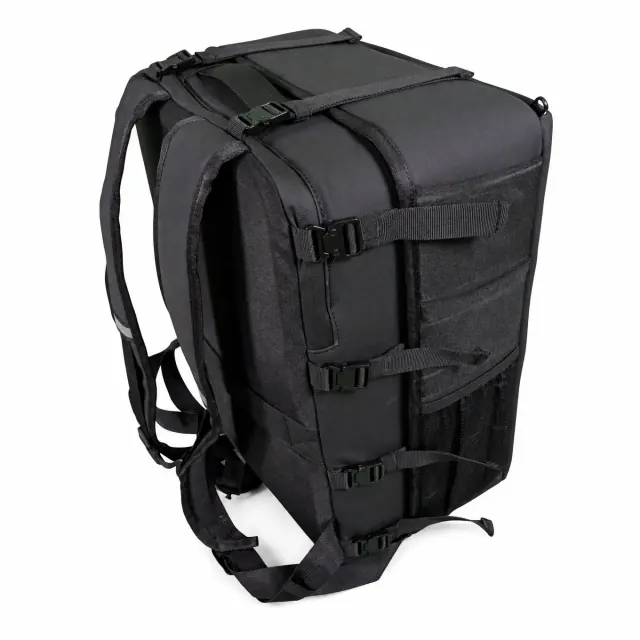
Fly light. Pay zero baggage fees.
Pack more, pay zero luggage fees.