
Packing8 min read
The Shoulder-Season Stack: One Bag for 8°C Mornings and 22°C Afternoons
September travel means 8°C mornings and 22°C afternoons in the same day. Here's the layering system that covers a 15-degree swing from one small bag.
By Ryan WearCo-founder of Ryanwear
The hardest week to pack for in Europe isn't January or August — it's the one you're about to fly into. From mid-September to early November, a single day in Kraków or Porto can start at 7°C in the dark and end at 21°C in full sun. The instinctive answer to that spread is volume: a jumper for the morning, a t-shirt for the afternoon, a jacket for the evening. Three garments, one of which is doing useful work at any given moment, all three riding around in a bag that's supposed to slide under a seat.
There's a better answer, and it isn't a bigger bag. It's treating your clothes as a system of thin layers you add and shed through the day, rather than as a set of daily outfits. Done properly, the whole autumn kit — about 17 pieces, enough for a week or considerably longer — fits the free personal item on most low-cost airlines, with the bulky bits on your body during the flight, where they cost nothing.
The swing is the problem, not the cold
Shoulder season is mild in absolute terms. What breaks packing plans is the gap between the morning low and the afternoon high, which across continental Europe regularly runs 10 to 13°C inside the same 24 hours.
Rough daily ranges in a normal year:
| City | Late September | Late October |
|---|---|---|
| Lisbon | 17–26°C | 14–21°C |
| Barcelona | 17–26°C | 13–21°C |
| Rome | 15–27°C | 11–20°C |
| Budapest | 11–21°C | 6–14°C |
| Kraków | 8–18°C | 4–12°C |
| Edinburgh | 9–15°C | 6–11°C |
Read those as two different trips. Lisbon in late September is a summer holiday with one cold half-hour after sunset. Kraków in late October is a proper autumn trip where your hands go in your pockets by five in the afternoon. The kit below handles both, because the layers are identical — you simply carry a different number of them and wear them in a different order.
Three layers beat six outfits
The layering principle is old, well tested and badly underused by city travellers who associate it with hiking. It has three jobs:
- Base. Touches your skin, moves sweat off it. A t-shirt or long-sleeve tee. Merino or a synthetic blend beats cotton here because it keeps working when damp and doesn't start to smell after one wear.
- Mid. Traps warm air. A light knit, a thin fleece or a packable insulated layer. This is where almost all your warmth comes from, and it's the layer people most often over-buy — thick equals bulky, not warmer, once you have two other layers around it.
- Shell. Blocks wind and water. Wind is what actually steals your heat on a bridge in Porto or a tram platform in Vienna; a very light windproof shell over a t-shirt feels warmer than a heavy jumper on its own.
The arithmetic is why this wins. Three layers give you eight combinations, from bare t-shirt at 24°C to all three at 6°C with wind. Six separate outfits give you six, all of them fixed at whatever temperature you guessed they'd be worn.
The 17-piece autumn kit
This is a full week and, with a sink and twenty minutes, three weeks. Adjust the count, not the categories.
- Four t-shirts or short-sleeve tops, merino or synthetic blend.
- One long-sleeve tee — the layer that does the most work in October.
- One shirt that reads as smart. Collar, buttons, no logo. It's your restaurant layer and your mid-layer.
- One light knit or thin fleece.
- One packable insulated jacket or light quilted layer, if you're going anywhere north or inland.
- One wind-and-rain shell that packs to about the size of a paperback.
- Two bottoms: one pair of trousers or jeans (worn on the plane), one lighter pair or a skirt/dress.
- Seven pairs of underwear.
- Four pairs of socks — one of them thicker, for the day the wind turns.
- A scarf or tube scarf. Twenty-five grams, and it changes a jacket's warmth more than a whole extra layer would.
Swimwear stays in if there's a thermal bath, a hotel pool or an Atlantic beach in the plan — Budapest and the Portuguese coast both argue for it well into October. Everything else you might be tempted to add is the fifth t-shirt, and you will not wear the fifth t-shirt.
What you wear through the gate
The kit above only fits a small bag because the shell, the knit, the trousers and the shoes are on your body when you board. That's not a trick — it's the whole design. Most low-cost airlines cap the free under-seat bag by dimensions, and dimensions are the constraint that matters:
| Airline | Free under-seat bag | Approx. volume |
|---|---|---|
| Ryanair | 40 x 20 x 25 cm | about 20 litres |
| Wizz Air | 40 x 30 x 20 cm | about 24 litres |
| easyJet | 45 x 36 x 20 cm | about 32 litres |
Those are the published limits at the time of writing and they change — check the airline's current policy before you fly, and note that Ryanair's box is the tightest of the three at roughly 20 litres. Pack to the smallest airline on your itinerary and everything else is easy.
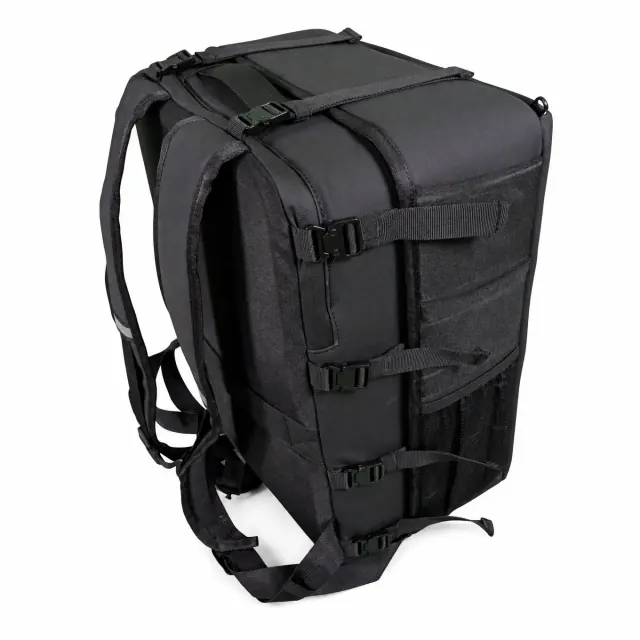
Twenty litres sounds impossible for seventeen garments until you weigh what's actually going in: four tees, a long-sleeve, a shirt, one spare bottom, eleven small items and a shell is not a lot of fabric. What kills it is air. Compression — straps, a firm roll, sitting on the bag while you close it — is worth more litres than any clever folding method. If you're choosing a bag for this, buy the compression, not the capacity; Ryanwear's own compression backpack is built to the Ryanair personal-item box for exactly that reason, but the principle holds whatever you're carrying.
One thing worth knowing at the gate: a soft bag that's slightly over-full can usually be squashed into a sizer, and a hard bag that's slightly over cannot. In shoulder season, when your bag is full of compressible knitwear rather than rigid summer sandals and sunscreen bottles, you have more margin than you think.
Rain is the part people get wrong
Autumn rain in Europe is rarely all-day and almost never heavy — it's twenty minutes, three times a week, usually while you're between things. That argues strongly for a shell and against an umbrella, which is bulky, one-handed and blows inside out on any Atlantic coast.
Two details make the shell version work. First, a hood: it removes the umbrella entirely. Second, dry feet — wet socks end a sightseeing day faster than cold ever does, which is why one of your four pairs should be a thicker, faster-drying pair and why your main shoes want to be something water-resistant rather than canvas.
Shoes, honestly
Shoes are the single biggest volume item in any autumn bag, so the rule is two pairs total and one of them is always on your feet.
- On your feet: the bulkier, warmer, more weatherproof pair. Walkable for 20,000 steps, dark enough to pass in a decent restaurant.
- In the bag: something flat and packable — a slim trainer, a loafer, an espadrille if you're going south. It should crush.
If you can't decide, ask what the trip's coldest wet evening looks like and wear that pair through the airport. A third pair means either a second bag or leaving your knit at home, and the knit is worth more.
A day in the stack
This is what it looks like in practice, on a mid-October day in Prague that runs 5°C to 14°C.
- 08:00, 5°C: tee, long-sleeve, knit, shell, scarf. All five on.
- 11:00, 10°C in the sun: shell off, into the bag. It weighs nothing there.
- 14:00, 14°C walking uphill: knit off too. You're in two thin layers and comfortable.
- 19:00, 8°C and breezy: knit back on, shell back on, scarf up. Same clothes, four different days.
Nothing here was carried for one temperature. That's the entire saving.
What stays home
- The heavy coat. It's a mid layer and a shell fused together, sized for the worst hour of the trip, and it can't be taken apart.
- The second pair of jeans. Denim is the densest thing you own per wear.
- Full-size toiletries. Shoulder-season trips are short and pharmacies exist in every European city.
- The just-in-case dressy item. If the smart shirt plus dark trousers doesn't get you into a restaurant, the restaurant wasn't going to have a table anyway.
The test for anything else: name the specific hour of the specific day you'll wear it. If you can't, it's not a garment — it's a hedge, and hedges are what turn a free personal item into a paid cabin bag.
Fly light. Pay zero baggage fees.
Pack more, pay zero luggage fees.