
Are Vacuum Bags Allowed on Planes? Pumps, Batteries and Hand Luggage in 2026
Yes — vacuum-sealed bags are allowed in hand luggage and in checked bags, although security may open them. The pump is the part that needs care. A separate battery pump is a portable electronic device and belongs in the cabin. A backpack with a pump built in counts as smart luggage: if its lithium battery is over 2.7 Wh and cannot be removed, it is not allowed on the plane at all. Or skip the question entirely — a manual compression backpack has no battery to declare.
- Vacuum-sealed bags: allowed in hand and checked luggage
- Separate battery pump: an electronic device — keep it in the cabin
- Built-in pump with a non-removable battery over 2.7 Wh: forbidden
- Vacuum bags: allowed
- Separate pump: cabin
- Built-in battery over 2.7 Wh: removable or forbidden
- Power banks: max 2 in 2026
Compression Backpack
€99.99
Free shipping across the EU
Vacuum bags, pumps and batteries: what goes where
The quick reference. The rules come from IATA’s 2026 guidance for passengers travelling with lithium batteries, EASA, the FAA and the TSA — your airline can be stricter, so check its page too.
| Vacuum bags, pumps and batteries: what goes where | Hand luggage | Checked baggage | Watch out for |
|---|---|---|---|
| Vacuum-sealed or roll-up compression bags | ✓ Allowed | ✓ Allowed | Security may open them — be ready to re-seal |
| Separate battery vacuum pump | ✓ Allowed as an electronic device (up to 100 Wh) | ~ Only switched fully off and protected — IATA says such devices should travel in the cabin | Pack it so it cannot switch on by accident |
| Bag with built-in pump, removable battery | ✓ Allowed | ~ Only with the battery taken out and carried in the cabin | Treated as “smart luggage” |
| Bag with built-in pump, non-removable battery over 2.7 Wh | ✗ Forbidden | ✗ Forbidden | Check the battery before you buy one |
| Power bank (for the pump or your phone) | ✓ Up to two per passenger (2026 rule) | ✗ Never | No charging power banks during the flight |
| Manual compression backpack (no battery) | ✓ Nothing to declare | ✓ Nothing to declare | It must still fit your airline’s size |
Sources: IATA, “Passengers travelling with lithium batteries” (revised for the 2026 regulations); EASA dangerous-goods guidance for passengers; FAA PackSafe pages on portable electronic devices and smart bags (updated 2025–2026); TSA “What can I bring?” — vacuum-sealed bags; ICAO addendum on power banks effective 27 March 2026. Checked October 2026.
Every rule in that table is about the pump
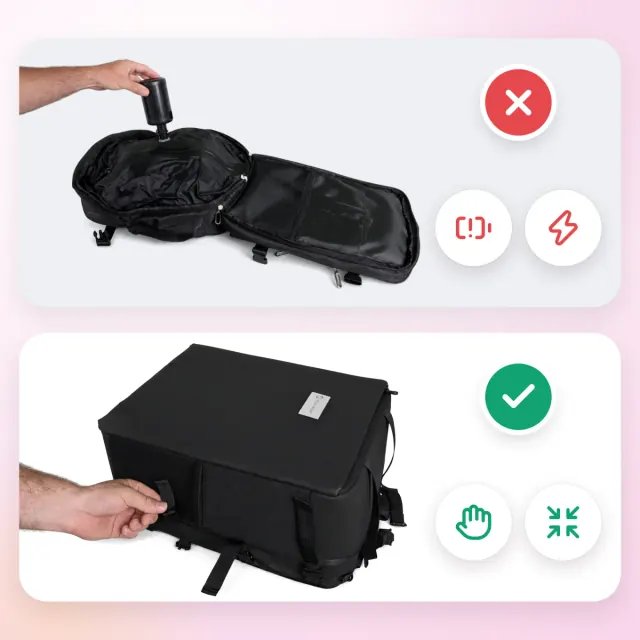
A vacuum system is never just a bag. It is the bag, the pump, the pump’s battery, a cable to charge it — and sometimes a power bank to do that on the road. Each of those has its own line in the airport rules.
A manual compression backpack is one thing: two hardshell halves and metal buckles. None of it appears on a battery list, so there is nothing to switch off, take out or explain at security.
- Vacuum system: bag + pump + battery + cable (+ power bank)
- Each part has its own line in the airport rules
- Manual compression: two hardshell halves and metal buckles — that is all
- ✗ Separate pump: an electronic device — best in the cabin, switched off
- ✗ Built-in battery over 2.7 Wh: must be removable, or the bag stays home
- ✗ Power bank for the pump: counts towards your two
- ✓ Ryanwear: nothing to charge, remove or declare
Compression with nothing to declare
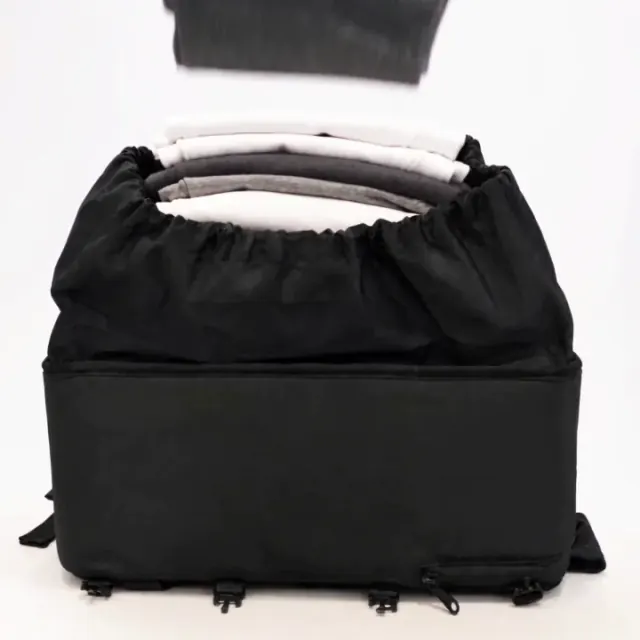
Every rule on this page exists because of one component: the battery. Take it away and the questions disappear. The Ryanwear Compression Backpack squeezes your clothes between two hardshell halves held by metal buckles — you overpack the base, press the lid down by hand and click it shut.
No pump to pack, no watt-hours to look up, no re-pumping after a bag check. Buckled shut, it sits at 40 × 30 × 20 cm, the free under-seat size on Ryanair, Wizz Air and Vueling.
- Every battery rule exists because of the pump
- Ours compresses with hardshell halves and metal buckles
- Buckled shut: 40 × 30 × 20 cm, the free under-seat size
- ✓ No battery, no pump, no watt-hours
- ✓ Re-cinch by hand after a bag check
- ✓ Quick-access box keeps liquids and power bank reachable
Vacuum bags and pumps on planes: the details
Are vacuum-sealed bags allowed in hand luggage?
Yes. A vacuum-sealed or roll-up compression bag is just a plastic bag with clothes in it, and no aviation rule forbids it in hand or checked luggage. The US TSA lists vacuum-sealed bags as allowed in both, with one caveat: if a bag alarms, an officer may need to open it for inspection. European airports publish no specific rule on them, and security staff anywhere can open a bag they need to look into.
In practice that is the real cost of vacuum bags: a dense, sealed brick is exactly the kind of item that gets a second look. If it is opened, you re-seal it — by rolling it again, or by finding power for the pump.
- No rule forbids vacuum-sealed bags in hand or checked luggage
- TSA: allowed, but officers may open a bag that alarms
- If it is opened, you re-roll or re-pump it yourself
Can you take a vacuum pump on a plane?
A small battery vacuum pump counts as a portable electronic device, like a phone or a shaver. IATA’s 2026 guidance allows devices with lithium batteries of up to 100 Wh without airline approval and says they should be carried in hand luggage; in checked baggage they must be switched completely off and protected from switching on. The FAA gives the same advice. Pocket vacuum pumps sit far below 100 Wh, so the practical rule is simple: pump in your hand luggage, switched off.
A manual pump or a roll-up bag has no battery at all and needs no special handling.
- Battery pump = portable electronic device (like a phone)
- Up to 100 Wh: belongs in the cabin (IATA and FAA)
- Checked only if fully off and protected; manual pumps need no special handling
Vacuum backpacks with a built-in pump: the smart-luggage rule
Some vacuum backpacks build the pump and its battery into the bag. IATA treats luggage with an integrated lithium battery as an electronic device in its own right — “smart luggage” — and the rule hinges on the battery. A tiny battery of 2.7 Wh or less is allowed. A larger battery must be removable: then the bag can fly in the cabin, and if it has to be checked the battery comes out and travels with you. A bag whose battery is over 2.7 Wh and cannot be removed is forbidden. EASA and the FAA apply the same logic.
Vacuum-bag makers rarely publish the watt-hour rating of their pumps, so check the battery before you buy a bag with a built-in pump — or before an airline does it for you at the gate, where a forced check-in is exactly when the rule bites.
- Built-in battery = smart luggage under IATA 2026 guidance
- 2.7 Wh or less: fine. Bigger: must be removable, else forbidden
- Watt-hour ratings are rarely published — check before you buy
Power banks in 2026: the two-bank limit
If your pump charges from a power bank, the newest rule matters too. An ICAO amendment in force since 27 March 2026 limits passengers to two power banks and bans recharging them on board; IATA is folding it into its dangerous-goods rules from 1 January 2027, and several airlines already apply stricter limits. Power banks were already banned from checked baggage everywhere.
That is one more reason the Ryanwear backpack keeps its quick-access box at the back: liquids, passport and your power bank stay reachable for the security tray, instead of buried under a week of clothes.
- Since 27 Mar 2026: max two power banks per passenger (ICAO)
- No recharging them in flight; never in checked baggage
- Keep them in the backpack’s quick-access box for the security tray
The size rule still applies — however you compress
Compression changes how much fits inside a bag; it never changes how big the bag is allowed to be. Airlines measure the bag as you present it at the gate. A 40 × 30 × 20 cm bag holds about 24 litres whatever method you use, and a vacuum backpack advertised at “40 litres” or “40 × 30 × 20 after expansion” is bigger than the sizer when it is full.
The Ryanwear backpack is built the other way round: its rigid shell holds 40 × 30 × 20 cm while it is buckled shut — the published free under-seat size on Ryanair, Wizz Air, Vueling, Volotea and TUI fly — and everything you compress has to fit inside that.
- Compression changes what fits, not the size you are allowed
- A 40 × 30 × 20 cm bag holds about 24 litres, whatever the method
- Ours holds 40 × 30 × 20 cm while buckled shut
Liquids, passport and power bank in their own box
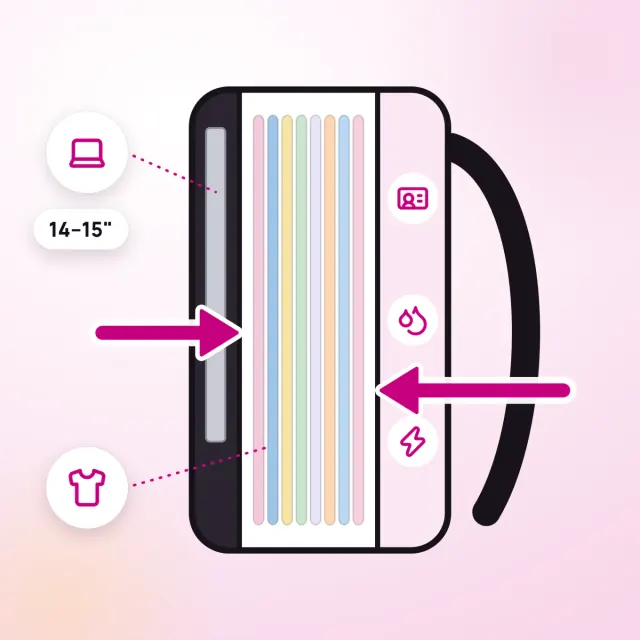
Security wants a few things out of your bag quickly: liquids, sometimes the laptop, and the power bank, which has to travel in the cabin anyway. In the Ryanwear backpack none of them sits in the compressed clothes. The laptop has a padded sleeve at the front, the clothes are pressed flat in the middle, and a separate quick-access box at the back holds liquids, passport and power bank.
So the usual tray routine never touches the main load — and if an officer does want to look inside, you press the lid down and re-buckle it afterwards, no pump needed.
- Security wants liquids, laptop and power bank out fast
- None of them sits in the compressed clothes
- If an officer looks inside: press the lid, re-buckle — no pump
- ✓ Front: padded sleeve for a 14–15″ laptop
- ✓ Middle: clothes pressed flat between two hardshell halves
- ✓ Back: quick-access box for liquids, passport and power bank
Vacuum backpack or manual compression?
Pumps, re-sealing after security, real space savings and the 40 × 30 × 20 sizer — the full comparison, including Airback and Vacpack.
Read the comparisonVacuum bags on planes: FAQ
Short, sourced answers — checked October 2026. Your airline can be stricter than the general rules, so read its page before you fly.
Are vacuum bags allowed in hand luggage?
Yes. Vacuum-sealed and roll-up compression bags are allowed in hand luggage and checked bags. The US TSA notes that officers may need to open a vacuum-sealed bag if it alarms, and security staff anywhere can inspect a bag — so be ready to re-seal it.
Can I take an electric vacuum pump in hand luggage?
Yes. A battery vacuum pump is a portable electronic device; under IATA’s 2026 guidance devices with lithium batteries of up to 100 Wh are allowed in hand luggage. Keep it switched off and protected from turning on.
Can a vacuum pump go in checked luggage?
Only if it is switched completely off and protected from accidental activation — and both IATA and the FAA say devices like this should travel in the cabin instead. The simplest choice is to keep the pump in your hand luggage.
Are vacuum backpacks with a built-in pump allowed on planes?
They count as smart luggage. If the built-in lithium battery is 2.7 Wh or less, it is allowed. If it is larger, it must be removable: the bag can then fly, and if it is checked the battery travels in the cabin. A non-removable battery over 2.7 Wh makes the bag forbidden (IATA 2026; EASA and the FAA agree).
Will airport security open my vacuum bags?
It can. Dense, sealed bags are a common reason for a second look, and officers may open them. Pack the bags where they are easy to reach, and bring a way to re-seal them — or use compression that needs no seal at all.
How many power banks can I take on a plane in 2026?
Two per passenger under the ICAO rule in force since 27 March 2026, and they may not be recharged on board. Power banks are never allowed in checked baggage, and some airlines set stricter limits.
Is there a compression backpack without a pump or battery?
Yes. The Ryanwear Compression Backpack compresses mechanically with two hardshell halves and metal buckles: overpack the base, press the lid down by hand, click it shut. It has no battery, so none of the rules above apply — it only has to fit your airline’s size, which it does at 40 × 30 × 20 cm buckled shut.
The easiest battery rule is no battery
Compress a week of clothes by hand, keep the airline size while buckled shut, and walk through security with nothing to switch off, remove or declare.
- No pump, no battery
- 40 × 30 × 20 cm buckled shut
- 4.8/5 from 677 reviews