
Vacuum Backpack or Manual Compression? What the Pump Really Costs You
A vacuum backpack squeezes the air out of your clothes with a pump; a manual compression backpack squeezes them with your hands and a rigid lid. Both get more in. The difference is everything around the squeeze: the pump you buy, charge and carry, the airtight zip you re-seal after a security check, and “after expansion” sizes that stop matching the sizer. Ours is 40 × 30 × 20 cm buckled shut, compresses with two hardshell halves and metal buckles, and has nothing to charge — ever.
- Vacuum: a pump sucks the air out. Manual: hands + a rigid lid press it flat
- Pumps need charging, carrying and re-pumping after security
- Ours: 40 × 30 × 20 cm buckled shut, nothing to charge
- No pump, no battery
- 40 × 30 × 20 cm buckled shut
- Re-cinch after security in seconds
- 14–15″ laptop sleeve
- 4.8/5 · 677 reviews
Compression Backpack
€99.99
Free shipping across the EU
Compression you can watch: overpack, press, buckle
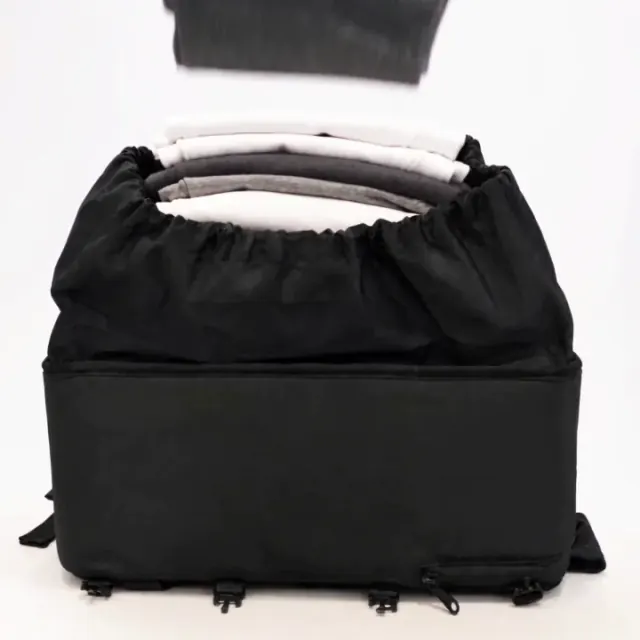
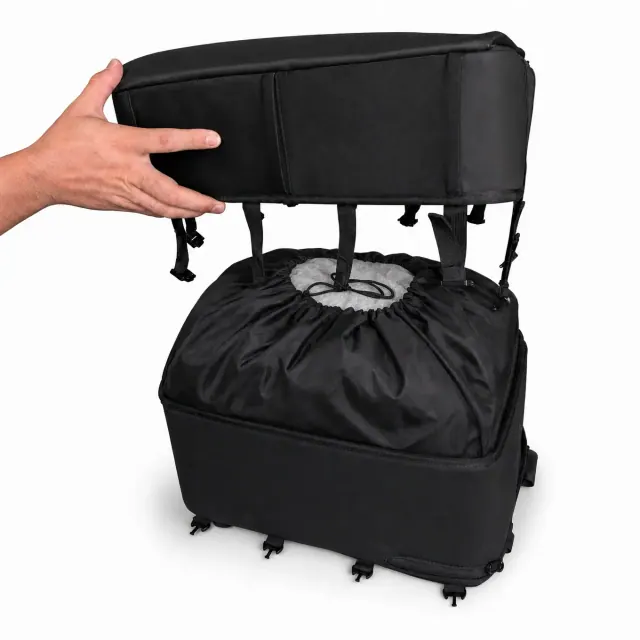
No valve, no hose, no wheezing pump. The clothes go into the hardshell base well above the rim — the fabric collar is built extra-tall for exactly that — the lid comes down, and the metal buckles hold everything at the backpack’s final size.
Because the squeeze is mechanical, it does not leak away over the trip and it does not need a socket to come back after a bag check. Press, click, done.
- Overpack above the rim — the collar is built for it
- Lid down, metal buckles hold the squeeze
- Nothing leaks, nothing to recharge after a bag check
- ✓ Holds 40 × 30 × 20 cm while buckled shut
- ✓ Re-cinch on the terminal floor — no power needed
- ✓ No airtight seal that can fail mid-trip
- ✓ Quick-access box for liquids, passport and power bank
Vacuum vs manual compression, side by side
Four ways to squeeze a week of clothes into a cabin bag. The squeeze is not the hard part — living with the system for a whole trip is.
| Vacuum vs manual compression, side by side | Manual compression (Ryanwear) | Vacuum backpack + separate pump | Vacuum backpack with built-in pump | Vacuum bags in a normal bag |
|---|---|---|---|---|
| How it compresses | Hardshell halves + metal buckles, by hand | Airtight compartment, emptied by a small USB pump | Pump and battery built into the bag | Pump or roll the air out of each bag |
| Something to charge | ✓ Never | ✗ The pump | ✗ The bag itself | ~ Electric pumps yes, roll-up bags no |
| After security opens it | ✓ Press the lid, re-buckle in seconds | ✗ Re-seal and re-pump before boarding | ✗ Re-seal and re-pump before boarding | ✗ Re-roll or re-pump every bag |
| Battery rules when flying | ✓ None — there is no battery | ~ The pump is an electronic device: keep it in the cabin | ✗ Integrated battery over 2.7 Wh must be removable — or the bag is forbidden | ~ Electric pump counts as a device |
| Size at the airline sizer | ✓ 40 × 30 × 20 cm while buckled shut | ~ Often sold with an expansion zip — check the packed size | ~ Same, and the pump takes up room | ~ Whatever the outer bag measures |
| Clothes on arrival | ~ Pressed flat and even; fold flat for fewer creases | ✗ Reviewers report heavy creasing | ✗ Reviewers report heavy creasing | ✗ Uneven crush, creases and gaps |
Battery rules: IATA “Passengers travelling with lithium batteries” (2026 edition), EASA and the FAA treat bags with integrated lithium batteries as electronic devices. Vacuum-backpack details from public product pages and independent reviews, checked October 2026; individual models differ.
Battery pump or your own two hands
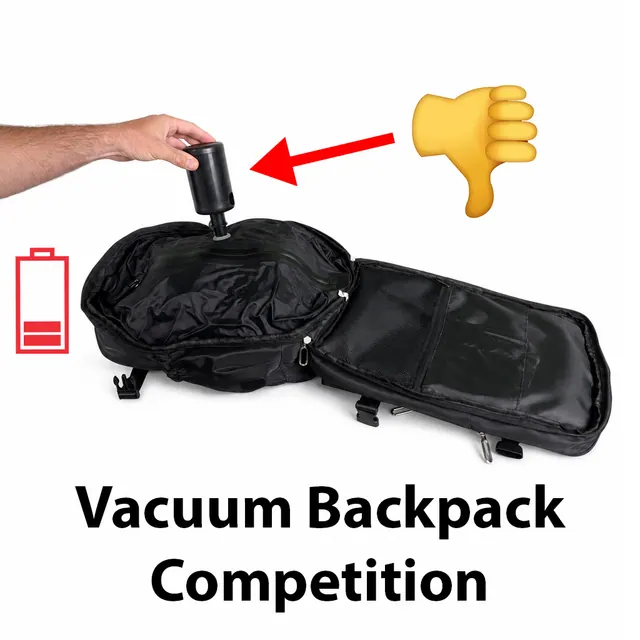
On the left, a typical vacuum backpack with its small battery pump: the pump sucks the air out of an airtight compartment — as long as it is charged. On the right, the Ryanwear Compression Backpack: the clothes go into the hardshell base above the rim, the lid comes down and your hands do the squeezing.
Both get more clothes into the bag. Only one of them still works when the pump is flat, there is no socket in sight or security has just opened your bag.
- Left: vacuum backpack + battery pump
- Right: hardshell lid + your hands
- Only one still works when the pump is flat
- ✗ The pump has to be charged before every squeeze
- ✗ Re-seal and re-pump after every bag check
- ✗ An expansion zip can make it bigger than the sizer
- ✓ Nothing to charge — the squeeze is mechanical
- ✓ Press the lid and re-buckle in seconds after a check
- ✓ Holds 40 × 30 × 20 cm while buckled shut
Same goal, fewer parts: in the Ryanwear backpack the squeeze is the bag itself.
Four moves, no pump
This is the whole compression system of the Ryanwear backpack — no valve, no hose, nothing to plug in.
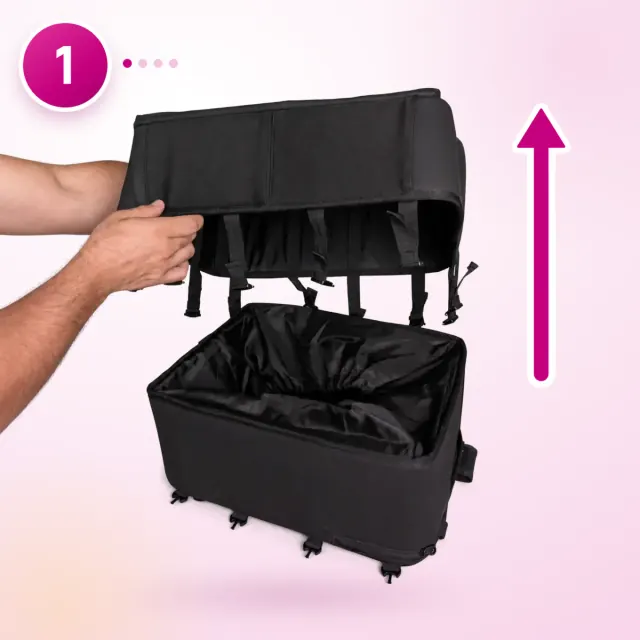
1. Open the buckles, lift the lid
The backpack comes apart into two halves: a hardshell lid with the shoulder straps, and a base with a tall fabric collar.
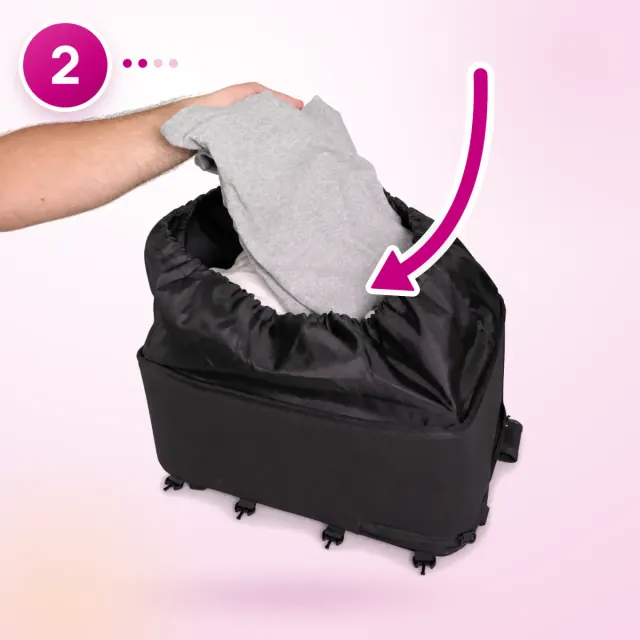
2. Pack above the rim
Lay the clothes in flat and keep going past the edge of the base — the tall collar is made for it. Then pull the drawstring closed.
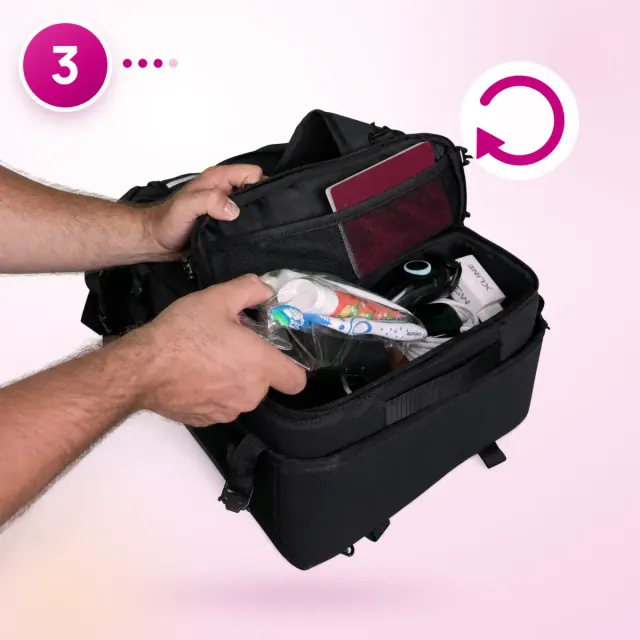
3. Lid on, then the quick-access box
Put the lid back and close the buckles loosely. Turn the backpack over and fill the separate box at the back: liquids, passport, power bank.
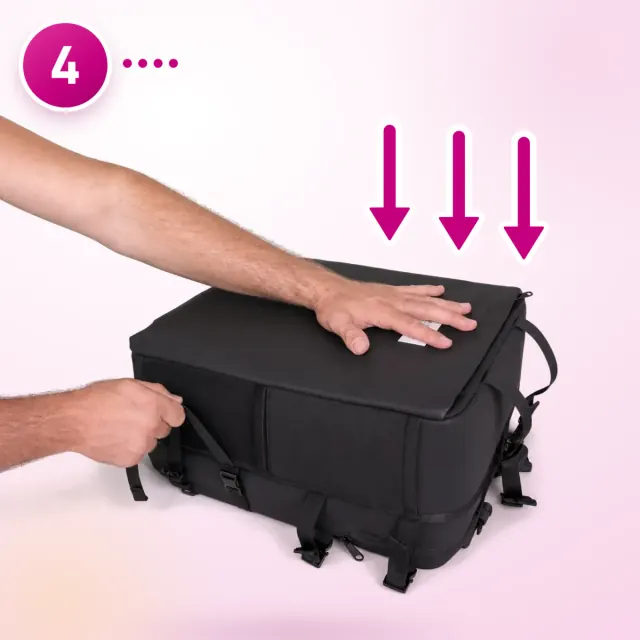
4. Press and buckle
Press the lid down with your hands — lean on it if you need to — and pull the straps tight. The metal buckles hold it at 40 × 30 × 20 cm.
What a vacuum backpack does — and what it quietly costs
How does a vacuum backpack work?
A vacuum backpack has an airtight main compartment with a one-way valve. You pack it, close the airtight zip, attach a small pump to the valve and suck the air out, so the clothes collapse and the compartment shrinks. Some brands sell the pump separately, a few build it into the bag, and the cheapest versions are a normal backpack with vacuum bags inside.
A manual compression backpack skips the air entirely. You overpack the base, close a rigid lid and pull it down with straps and buckles, so the clothes are pressed flat between two firm surfaces. Same goal, fewer moving parts: no valve to leak, no seal to fail, no pump to remember.
- Vacuum: airtight compartment + valve + pump sucks the air out
- Manual: overpack, close a rigid lid, buckle it down
- Fewer parts: no valve, no seal, no pump to forget
Do vacuum backpacks really save that much space?
They save space — just usually less than the box says. Vacuum backpacks are typically sold on “up to 50% more space”, while independent reviewers measure less: one 2026 review of a popular under-seat model put the real reduction at about 20–30%, and a 2024 Condé Nast Traveller review found the capacity was “not doubled”. Consumer Reports’ June 2025 look at the Vacpack also flagged the separately sold pump, a six-hour charge and a compression zip that takes real strength to close.
The other half of the bargain is what travels with you. A pump that lives in your bag uses some of the space it saved, a dead pump means an uncompressed bag, and several reviewers describe vacuum-packed clothes as badly creased. Our design brief went the other way: keep the squeeze, delete the electronics. The backpack is built to pack up to three times what a regular backpack of the same size holds, and it presses clothes between flat surfaces instead of crushing them unevenly.
- Sold on “up to 50%”; independent reviews measured ~20–30% on one model
- The pump rides in your bag, and a flat battery means no compression
- Manual: built to pack up to 3× a regular backpack of the same size
Vacuum shrinks the clothes, not the bag
Here is the detail most vacuum listings skip. A bag that measures 40 × 30 × 20 cm holds about 24 litres — that is simply the volume of the box. When a vacuum backpack is advertised at “40 litres” or as 40 × 30 × 20 cm “after expansion”, the extra room comes from an expansion zip that makes the bag bigger than the sizer the moment you use it.
Airlines measure the bag as you present it at the gate, not how small it could be. So the useful question is never “how much does it hold expanded?” but “what size is it when it is full and closed?” Ours answers that with a rigid shell: buckled shut, it sits at 40 × 30 × 20 cm, the free under-seat size on Ryanair, Wizz Air, Vueling, Volotea and TUI fly.
- 40 × 30 × 20 cm is about 24 litres — that is the box
- “40 L” or “after expansion” means bigger than the sizer when used
- Airlines measure the bag as presented; ours stays 40 × 30 × 20 buckled
Airback, Vacpack and the Ryanair size question
If you are looking for an Airback or Vacpack alternative for budget airlines, check two things before anything else: the packed size and the pump. Vacuum backpacks are often designed around US carry-on dimensions — Vacpack’s backpack is listed at 49 × 32 × 24 cm, which on Ryanair is a paid overhead bag, not the free under-seat one — and under-seat models tend to reach 40 × 30 × 20 cm only with the expansion zip closed.
Also check which Ryanair size a listing quotes. Ryanair’s free bag has been 40 × 30 × 20 cm since 4 September 2025; some vacuum bags are still advertised against the old 40 × 20 × 25 cm allowance. A manual compression backpack built to the current published size, with no pump to buy and no battery to declare, is the simpler alternative.
- Check the packed size and the pump before the brand
- Vacpack is listed at 49 × 32 × 24 cm — a paid overhead bag on Ryanair
- Ryanair’s free bag: 40 × 30 × 20 cm since 4 Sep 2025, not 40 × 20 × 25
Can you take a vacuum pump on a plane?
Usually yes, with conditions. A separate battery pump counts as a portable electronic device: carry it in the cabin. A backpack with a pump built in counts as “smart luggage” under IATA’s 2026 guidance — if its lithium battery is over 2.7 Wh and cannot be removed, the bag is forbidden; if it can be removed, the battery has to fly in the cabin. Vacuum-sealed bags themselves are allowed, though security may open them.
With a manual compression backpack none of this applies: there is no battery to check, declare or remove. We keep a full guide to vacuum bags, pumps and batteries on planes, with the official sources.
- Separate pump = electronic device: keep it in the cabin
- Built-in pump: non-removable battery over 2.7 Wh = forbidden (IATA 2026)
- Manual compression: no battery, nothing to declare
You saved space. Now pack the pump.
A vacuum backpack’s pump travels with you — to the hotel, back home and through every security check. It takes up room inside the bag you have just made smaller, and the clothes around it collapse unevenly into lumps and gaps.
A manual compression backpack leaves nothing to pack afterwards: press the lid flat, close the metal buckles and the backpack is done.
- The pump travels with you — inside the bag you just shrank
- Vacuum crush: lumps, gaps and creases
- Manual compression: press flat, buckle, done
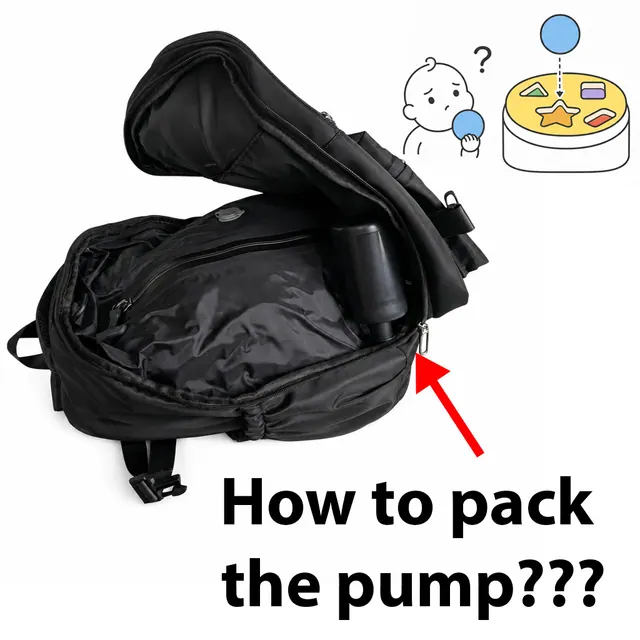
- ✗ The pump takes up room in the bag it just emptied
- ✗ Clothes collapse unevenly — reviewers report heavy creasing
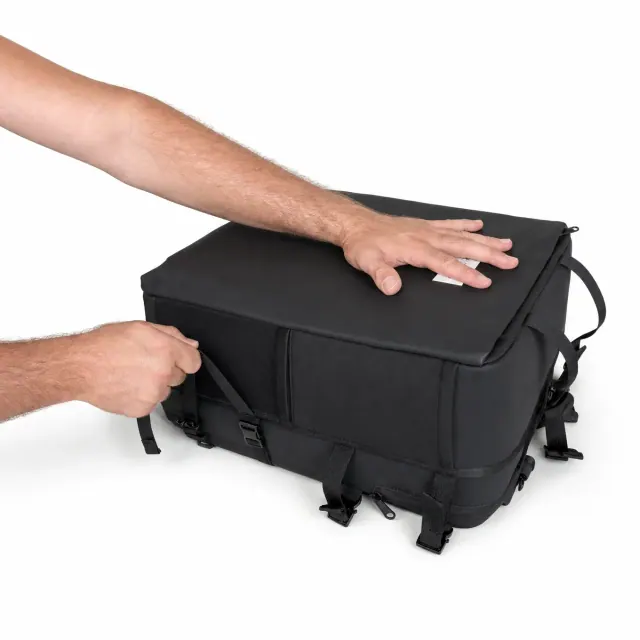
- ✓ Nothing extra to pack
- ✓ Clothes pressed flat and even between two hardshell halves
Keep the squeeze. Lose the pump.
Where 40 × 30 × 20 flies free
Buckled shut, the backpack sits at the exact published size below. Live table for EU and US carriers in cm and inches, checked against each airline’s own baggage page.
Europe
| Airline | Free item · max | Fits | ||
|---|---|---|---|---|
| easyJet | 45× | 36× | 20 | Your backpack fits this airline's free item |
| Eurowings | 40× | 30× | 25 | Your backpack fits this airline's free item |
| Ryanair | 40× | 30× | 20 | Your backpack fits this airline's free item |
| TUI fly | 40× | 30× | 20 | Your backpack fits this airline's free item |
| Volotea | 40× | 30× | 20 | Your backpack fits this airline's free item |
| Vueling | 40× | 30× | 20 | Your backpack fits this airline's free item |
| Wizz Air | 40× | 30× | 20 | Your backpack fits this airline's free item |
Not responsible for airline changes. Verify before you fly.
Pump in your bag? Read the 2026 battery rules
Vacuum bags, separate pumps, bags with a built-in pump and power banks — what IATA, EASA and the FAA actually allow in the cabin and the hold, with the official sources.
Vacuum bags on planes: the rulesVacuum backpack vs compression backpack: FAQ
Sourced, dated answers — current for October 2026.
Is a vacuum backpack worth it?
For most budget-airline travellers, no. Vacuum backpacks do save space, but independent reviews measure less than the advertised “up to 50%”, the pump has to be bought, charged and carried, and the bag must be re-pumped whenever security opens it. A manual compression backpack keeps the squeeze without the pump, the battery or the seal.
Which packs more: a vacuum backpack or a compression backpack?
It depends on the outer size, not the method. Vacuum backpacks often gain capacity through an expansion zip, which also makes the bag bigger. At a fixed 40 × 30 × 20 cm — about 24 litres — what matters is how hard the clothes are pressed and how evenly. The Ryanwear backpack is built to pack up to three times what a regular backpack of the same size holds, with no pump.
Can I use a vacuum backpack on Ryanair?
Only if it measures 40 × 30 × 20 cm or less as you present it at the gate — Ryanair’s free bag size since 4 September 2025. Many vacuum backpacks are US carry-on sized or reach that size only with the expansion zip closed. A larger bag needs Priority, or costs around €70–75 at the gate (2026).
Are vacuum backpacks allowed on planes?
Generally yes. Vacuum-sealed bags are allowed, though security may open them. A separate battery pump should travel in the cabin. A bag with a built-in pump is treated as smart luggage: under IATA’s 2026 guidance a non-removable lithium battery over 2.7 Wh makes it forbidden, and a removable one must go in the cabin.
What is a good Airback alternative?
If you fly budget airlines, a manual compression backpack built to 40 × 30 × 20 cm: it compresses without a pump, holds the airline size while buckled shut, and has no battery to charge or declare. The Ryanwear Compression Backpack also has a quick-access box for liquids and a 14–15″ laptop sleeve.
Do vacuum bags wrinkle clothes?
Often, yes — the bag collapses unevenly, and several reviewers describe vacuum-packed clothes as heavily creased. Pressing clothes between two flat surfaces is gentler; fold them flat and roll where you can. No compression method is completely crease-free.
Does a compression backpack need a pump?
No — only vacuum backpacks do. The Ryanwear Compression Backpack compresses mechanically: you overpack the base, press the lid down by hand and lock the metal buckles. Nothing to charge, no seal to maintain.
Keep the squeeze. Lose the pump.
Overpack above the rim, press, buckle — and walk to the gate at 40 × 30 × 20 cm with nothing to charge, nothing to re-pump and nothing to declare.
- No pump, no battery
- Free shipping across the EU
- 4.8/5 from 677 reviews