
Compression Backpack
€99.99
Color: Black
1
Free shipping across the EU
Packing cubes organise; they barely shrink anything. Compression cubes add a second zip and squeeze a little more. Vacuum and roll-up bags squeeze hardest, but crease your clothes and need re-sealing whenever security opens them. And here is the part most comparisons skip: none of them changes the size of the bag around them, which is the only thing the airline measures. A compression backpack does the squeezing with its own rigid shell — and holds 40 × 30 × 20 cm while it is buckled shut.
Compression Backpack
€99.99
Free shipping across the EU
The space figures are the ranges commonly quoted by brands and comparison sites — real results depend on what you pack and how hard you squeeze.
| Four ways to pack, compared | Compression backpack (Ryanwear) | Packing cubes | Compression cubes | Vacuum or roll-up bags |
|---|---|---|---|---|
| What it does | Presses clothes between two hardshell halves | Sorts clothes into zipped fabric boxes | Sorts, then squeezes with a second zip | Pushes the air out of a plastic bag |
| Space saved (typical claim) | Built to pack up to 3× a regular backpack of the same size | ~ Little — mostly organisation | Often quoted around 30% | Often quoted 30–60% |
| Shrinks the bag you carry | ✓ Holds 40 × 30 × 20 cm while buckled | ✗ No | ✗ No — dense cubes can still bulge the bag | ✗ No — and dense bricks bulge soft bags |
| Clothes on arrival | ~ Pressed flat and even | ✓ Least creasing | ~ Some creasing when cranked tight | ✗ Heavy creasing is common |
| Needs a pump or power | ✓ No | ✓ No | ✓ No | ~ Roll-up bags no, electric pumps yes |
| After a security check | ✓ Press and re-buckle in seconds | ✓ Just zip it | ~ Re-zip the compression zip | ✗ Re-roll or re-pump every bag |
Space ranges are the ones commonly published by brands and comparison sites as of October 2026, not our own measurements. “Up to 3×” is our design claim for the backpack versus a regular backpack of the same outer size.
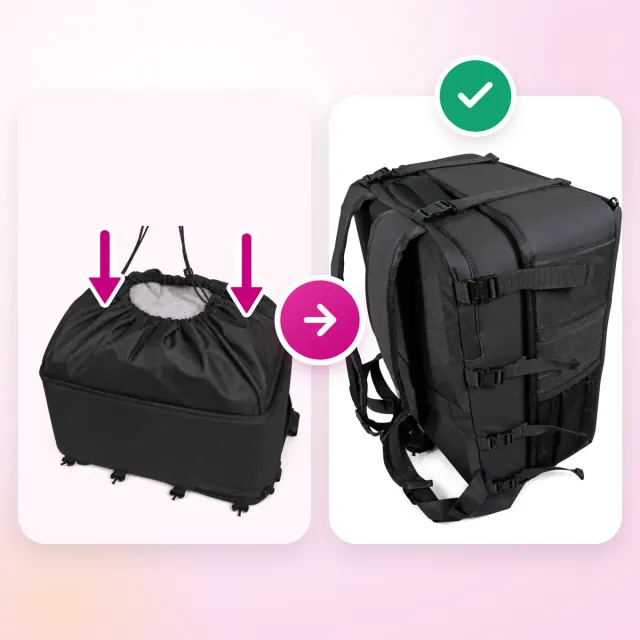
A packing cube shrinks a stack of T-shirts, and the soft bag around it is still free to bulge. The Ryanwear backpack turns that around: the base is the cube. You pack it well past the rim, the lid presses everything flat between two hardshell halves, and the buckled bag ends up at its own size — 40 × 30 × 20 cm — with the clothes inside it.
One big flat layer also packs better than six small bricks: no gaps between cubes to stuff with loose socks, and no fabric walls taking up room of their own.
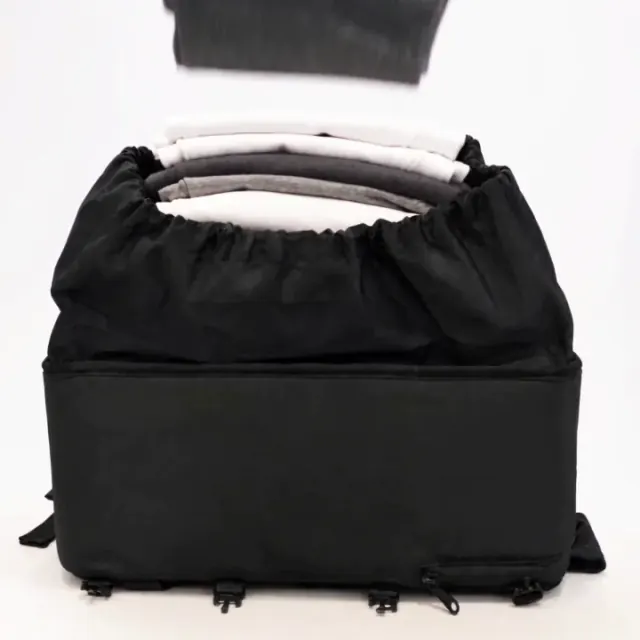
Cubes and vacuum bags compress the clothes and leave you to fight the bag. Here it is the other way round. Lay the clothes flat in the hardshell base — piled well above the rim, the tall fabric collar is built for it — close the lid and pull the straps until the metal buckles lock.
The squeeze is held by the shell, so the bag itself sits at its final size, and the things you need at security live in a separate quick-access box at the back.
Not much — and that is not what they are for. A packing cube is a zipped fabric box: it keeps T-shirts with T-shirts and makes it easy to find things in a hotel room, but the clothes inside take up roughly the same room as before, plus the fabric of the cube. Where cubes do help is packing discipline: a fixed box stops you adding “just one more” item.
If your problem is finding things, cubes are great. If your problem is that everything will not fit into a free under-seat bag, cubes alone will not solve it.
Vacuum and roll-up bags squeeze harder. Compression cubes use a second zip to pull the cube thinner, and brands and comparison sites typically quote savings around 30%. Vacuum bags remove the air itself and are often quoted at 30–60% — but the result is a dense, rigid brick that creases clothes, can be opened at security, and has to be re-rolled or re-pumped every time it is opened.
There is also a weight trap: when you squeeze more in, you carry more. Compression adds no weight of its own, but a bag that holds more clothes simply weighs more — worth remembering on airlines with a weight limit.
This is the detail that decides whether you pay at the gate. Cubes and vacuum bags shrink the clothes, but they sit inside a soft bag that bulges wherever the bricks push it. Airlines measure the bag as you present it, so a soft backpack stuffed with dense cubes can fail a 40 × 30 × 20 cm sizer even though every cube is perfectly compressed.
A compression backpack works the other way round: the outer shell is what compresses, so the bag holds its size. Buckled shut, the Ryanwear backpack sits at 40 × 30 × 20 cm — the published free under-seat size on Ryanair, Wizz Air, Vueling, Volotea and TUI fly — and it fits easyJet’s larger 45 × 36 × 20 cm under-seat bag with room to spare.
The classic packing hack is “roll, don’t fold”. Rolling is great for things that travel in tubes — the pockets of a packing jacket, the inside of a stuffable neck pillow, or a cube. In a compression backpack, fold flat instead: flat layers press evenly between the two shell halves, so clothes come out the way they went in.
The smartest system uses each method where it works best: fold the main load flat into the backpack, roll tomorrow’s outfit into the neck pillow, and roll the bulky extras into the jacket you wear on the plane.
Here is how a week of clothes travels without a single cube. The backpack takes the main load, folded flat and pressed shut at 40 × 30 × 20 cm, with the security items in the quick-access box. The Packing Jacket carries a full outfit rolled into the tube pockets of its lining, and you wear it on board. The stuffable neck pillow holds a change of clothes and doubles as your pillow on the flight.
Three items, no pumps, no cubes — and on airlines whose free bag is 40 × 30 × 20 cm, no cabin-bag fee. Buy all three together and the pillow is free.
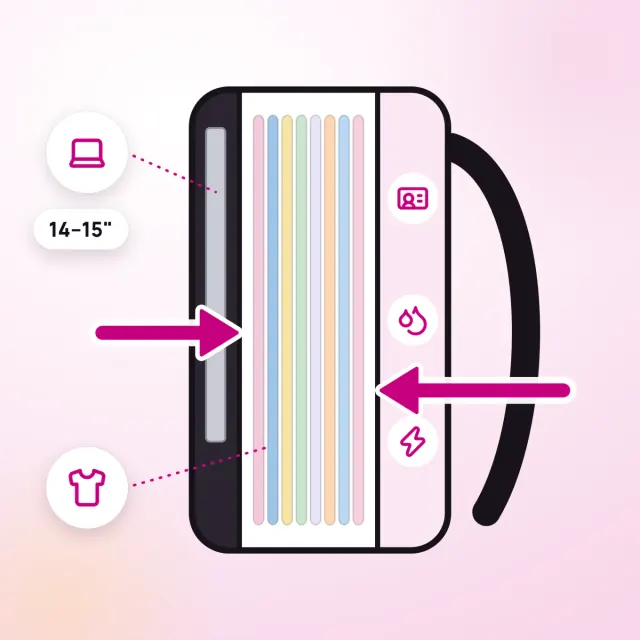
Most people buy cubes for the order, not the squeeze — and that is fair. The Compression Backpack has the order built in: a padded laptop sleeve at the front, the clothes pressed flat in the middle, and a separate quick-access box at the back for the things you reach for most.
If you love sorting, a small pouch for underwear or cables still fits. You just do not need a whole set of cubes to keep a week of clothes tidy.
The step-by-step 40 × 30 × 20 packing list: what to wear, what to compress, what to roll — and which airlines it works on.
Pack a week in a personal itemBackpack for the main load, jacket for an outfit you wear, pillow for a change of clothes. Add all three and the pillow is free.
Straight answers — current for October 2026.
They are worth it if you want organisation plus a modest squeeze — brands and comparison sites typically quote around 30%. They do not make your bag smaller, so in a soft backpack the dense cubes can still make the bag bulge. If you fly with a strict under-seat size, a bag that compresses itself is the stronger fix.
For organisation, packing cubes. For squeezing, vacuum or roll-up compression bags — at the cost of creased clothes and re-sealing after every security check. A compression backpack combines the squeeze with a bag that holds its airline size while buckled shut.
Usually yes: vacuum and roll-up bags are often quoted at 30–60% compared with little for ordinary cubes. But they crease clothes, can be opened at security, and turn into dense bricks that bulge a soft bag.
You can, but you do not need to: the backpack compresses the clothes itself, and flat layers press more evenly than cubes. Use a small pouch for underwear or cables if you like the organisation.
Both, in the right places. Roll clothes for tube-shaped spaces like the Packing Jacket’s pockets and the neck pillow. Fold them flat for the compression backpack, where flat layers press evenly and come out with fewer creases.
No — they only care about the size (and on some airlines the weight) of the bag as you present it. That is why a bag that holds its size while compressed is safer at the sizer than a soft bag full of dense cubes.
No cubes, no vacuum bags, no pump: overpack the base, press the lid, buckle it — and walk to the gate at 40 × 30 × 20 cm.
We use strictly necessary cookies to make this site work (e.g. your shopping cart and security). With your consent we may also use analytics and marketing cookies. You can accept all, reject non-essential cookies, or choose what to allow. Read our Cookie Policy and Privacy Policy.
€99.99
Free shipping across the EU
€79.99
Free shipping across the EU
€29.99
Free shipping across the EU