
The Compression Backpack Without a Pump — No Battery, Nothing to Break
If you're hunting for a compression backpack without a pump, this is it: two hardshell halves and metal buckles do the squeezing, powered by nothing but your own hands. Overpack above the rim, press the lid down, cinch — and the rigid shell holds everything at the 40 × 30 × 20 cm free-bag size flown by Ryanair, Wizz Air and Vueling. No charging, no seals, no motor wheezing at midnight. Just compression that works on every single trip.
- Hardshell halves + metal buckles — no pump, no battery
- Overpack, press, cinch down to 40 × 30 × 20 cm
- Nothing to charge, nothing to break
- No pump, no battery
- Hardshell + metal buckles
- 40 × 30 × 20 cm buckled shut
- Fits 14–15″ laptops
- 4.8/5 · 677 reviews
Compression Backpack
€99.99
Free shipping across the EU
The problem with vacuum compression backpacks
Every ranking review and one-bag forum lands on the same objections. We didn't build a better vacuum backpack — we removed the vacuum.
A pump you have to charge
Consumer Reports' June 2025 review of the Vacpack flagged the obvious: the pump needs charging, and a dead pump means an uncompressed bag. Your hands, by contrast, hold their charge indefinitely — even after a fourteen-hour layover.
- Dead pump = uncompressed bag (Consumer Reports, Jun 2025).
- Hands never need a charger.
Extra steps on every repack
Vacuum systems add a ritual: bag in, seal shut, connect pump, wait out the wheeze — extra prep steps on every single repack, the drawback ranking reviews keep listing. Buckles take one press and two clicks, so the compression actually gets used.
- Seal, pump, wait — every single repack.
- Buckles: press, click, done.
The pump is dead weight
Here's the paradox reviewers keep hitting: the pump and its battery ride inside your bag, eating a chunk of the space they just saved. A manual system's machinery is two shell halves and a set of metal buckles — already part of the backpack.
- The pump eats the space it just saved.
- Our machinery IS the backpack.
Vacuum crush = wrinkles
Vacuum bags compress unevenly, so clothes come out crumpled, with odd gaps where the plastic collapsed. Two flat hardshell halves press evenly, like a giant book — fold flat, roll where you can, and outfits come out the way they went in.
- Uneven vacuum crush wrinkles clothes.
- Flat shells press evenly — nearly wrinkle-free.
Security opens it — then what?
Checkpoints open bags. With a vacuum system that means finding an outlet and re-pumping before you board — a chore the vacuum reviews cite again and again. Metal buckles re-cinch on the terminal floor in seconds, no power required.
- Vacuum: re-pump after every inspection.
- Buckles: re-cinch in seconds, anywhere.
Seals fail. Buckles don't care.
Lose the vacuum seal mid-trip — a nicked bag, a tired valve — and you're carrying everything uncompressed for the rest of the holiday. There is no seal here. Two rigid halves and metal buckles hold the squeeze mechanically, trip after trip.
- A failed seal ruins the rest of the trip.
- Mechanical compression has no seal to fail.
Watch the buckles do the compressing
Yes, it saves you cash. Packs up to 3x more than regular backpacks. But honestly? It’s just a ridiculously good backpack.
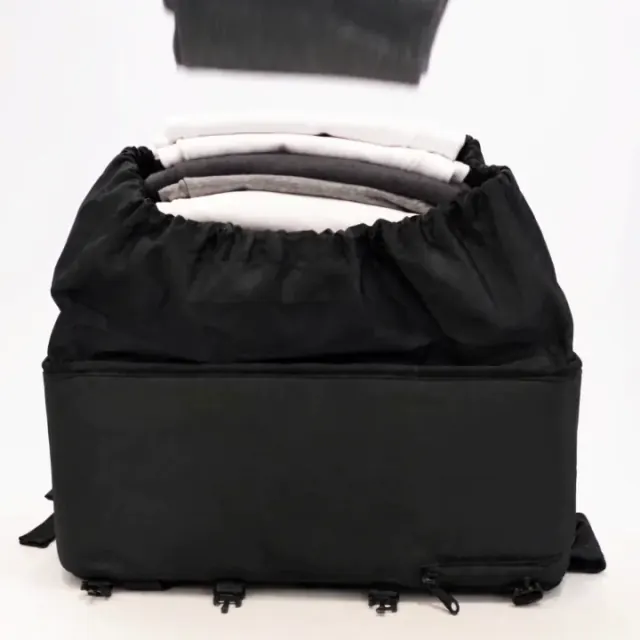
Pop the buckles, lift off
Flick open the metal buckles and lift the lid wide. That’s all the machinery there is — no pump, no vacuum, no power, no batteries. The compression is built into the backpack itself, so it works anywhere, on every trip, with nothing to charge and nothing to break.
Compression backpack without a pump: the honest engineering
How does a compression backpack work without a pump?
You compress clothes without a vacuum pump by using leverage instead of suction: pack above the shell rim, close the lid, and let two rigid halves plus metal buckles press everything down to 40 × 30 × 20 cm — then hold it there for the whole trip.
Here's the full routine. Lay your clothes flat into the hardshell base — however they go in is how they come out, because flat, even pressure doesn't churn them the way a collapsing vacuum bag does. The fabric collar is built extra-tall on purpose, so pile it well past the line you'd call full. Cinch the drawstrings, drop the lid, and press down with your hand — or lean in with your full bodyweight for a properly flat squeeze. The buckles are metal and the straps are sewn to take it, so go hard.
Around the back, a quick-access box takes everything you'll grab in a hurry: liquids for security, passport, powerbank. A padded sleeve fits a 14–15″ laptop — roughly 95% of laptops make the cut. That's the entire system. No motor, no valve, no charger: a manual compression backpack works in a hostel dorm at 6 a.m. exactly as well as it works at home.
- Overpack above the rim, cinch, press the lid, lock the metal buckles
- Flat, even pressure — clothes come out the way they went in
- Quick-access box for liquids, passport, powerbank; 14–15″ laptop sleeve
Is a vacuum compression backpack worth it?
For most travellers, no — the space saving is real, but you pay for it in process, and the process is exactly what breaks. Consumer Reports' review of the Vacpack (June 2025) flagged the pump-charging routine, and the one-bag community keeps repeating the same list: extra prep steps on every repack, a pump and battery that ride along as dead weight, uneven vacuum crush that wrinkles clothes, and the joy of re-pumping when security opens your bag.
The numbers don't rescue it either. Ranking comparisons typically credit vacuum systems with a 30–40% space saving, compression packing bags with up to 60%, and double-zip packing cubes with around 30% — so the electric option isn't even the biggest squeeze in the category. It's just the most complicated one.
A manual compression backpack for travel keeps the part that matters — the squeeze — and deletes the failure modes. Our design brief was blunt: your own bodyweight on a rigid lid out-presses a tiny battery pump, packing up to 40% more in, with nothing to charge before a flight and nothing to fail during one. If the pump is the product's weak point, the fix isn't a better pump.
- Reviewers flag charging, extra steps, dead weight, wrinkles (Consumer Reports, Jun 2025)
- Vacuum saves 30–40% per ranking comparisons — compression bags hit 60%, cubes ~30%
- Manual hardshell keeps the squeeze, deletes the failure modes
Manual compression backpack vs vacuum: the Airback alternative question
The most practical Airback alternative is a manual compression backpack: you keep the compression and drop the pump, the battery, and the seal the whole system depends on.
Credit where due — vacuum backpacks genuinely shrink bulky loads (30–40% per ranking comparisons), and watching a puffer jacket deflate is undeniably satisfying. But the same reviews list the price: charge the pump, seal the bag, wait out the wheeze, then find room for the pump itself — and if the seal relaxes mid-trip, you're carrying an uncompressed bag until you find an outlet.
The cheaper alternatives each solve half the problem. Packing cubes (~30% per ranking comparisons) organize beautifully but do nothing about the bag's outer size — the fabric bulges wherever it likes. Compression straps squeeze a roll of clothes, but the bag around them stays floppy, and floppy is what loses arguments at a sizer.
A hardshell does what none of them can: once it's packed, pressed and buckled, the rigid shell holds the whole bag at 40 × 30 × 20 cm — not just your clothes compressed, but the backpack itself sitting at an exact, published airline size for as long as it stays closed.
- Vacuum: real 30–40% saving, but charging, steps, weight and seal risk
- Cubes organize (~30%), straps squeeze — neither holds the bag's outer size
- Buckled shut, the hardshell holds the whole bag at 40 × 30 × 20 cm
Do airlines measure your bag compressed or uncompressed?
Airlines measure the bag as presented: whatever state your backpack is in when it meets the sizer is the state that counts. Nobody asks how small it could be — they look at how big it is right now.
That rule is brutal for vacuum systems (pumped flat at home, slowly relaxing all the way to the gate) and kind to buckles: press, cinch, and walk to boarding already at final size. While the backpack is buckled shut, the rigid shell holds it at 40 × 30 × 20 cm — there's no soft fabric to bulge past the frame, which is exactly the argument a stuffed duffel loses.
As of July 2026, 40 × 30 × 20 cm is the exact published free under-seat bag size on Ryanair, Wizz Air, Vueling, TUI fly and Volotea — and it fits inside easyJet's roomier 45 × 36 × 20 allowance with air to spare. One habit to keep: compress and buckle before you queue, so the bag you present is the bag we built — the exact published size, not a centimetre of bulge more.
- Airlines judge the bag as presented at the gate — so present it compressed
- Buckled shut, the shell holds 40 × 30 × 20 cm; no soft-bag bulge
- The free-bag size on Ryanair, Wizz Air, Vueling, TUI fly and Volotea (July 2026)
Check your airline: where 40 × 30 × 20 flies free
Buckled shut, the backpack sits at the exact published size below. Live table for EU and US carriers — cm and inches, verified against each airline's own baggage page, updated July 2026.
Europe
| Airline | Free item · max | Fits | ||
|---|---|---|---|---|
| easyJet | 45× | 36× | 20 | Your backpack fits this airline's free item |
| Eurowings | 40× | 30× | 25 | Your backpack fits this airline's free item |
| Ryanair | 40× | 30× | 20 | Your backpack fits this airline's free item |
| TUI fly | 40× | 30× | 20 | Your backpack fits this airline's free item |
| Volotea | 40× | 30× | 20 | Your backpack fits this airline's free item |
| Vueling | 40× | 30× | 20 | Your backpack fits this airline's free item |
| Wizz Air | 40× | 30× | 20 | Your backpack fits this airline's free item |
Not responsible for airline changes. Verify before you fly.
One shell, one size, five EU airlines
The same buckled-shut 40 × 30 × 20 shell matches the free personal-item size on Ryanair, Wizz Air, Vueling and more. See the full size-by-size breakdown.
Read the 40×30×20 cabin bag guideCompression without a pump: your questions
Straight answers on manual vs vacuum compression — sourced, quotable and current for July 2026.
Do compression backpacks need a pump?
No — only vacuum compression backpacks do. The Ryanwear Compression Backpack compresses mechanically: two hardshell halves and metal buckles press an overpacked load down to 40 × 30 × 20 cm and hold it there. Nothing to charge, no seal to maintain, nothing to break.
Is a vacuum compression backpack worth it?
For most travellers, no. Reviewers — including Consumer Reports on the Vacpack (June 2025) — keep flagging the same problems: a pump that needs charging, extra steps on every repack, the pump's own weight riding in your bag, and wrinkled clothes from the uneven crush. A manual hardshell system delivers the same category of space saving with none of those failure modes.
Do airlines measure a compression backpack compressed or uncompressed?
Airlines measure the bag as you present it at the gate — the state it's in when it meets the sizer is what counts. So compress and buckle before boarding: closed, the rigid shell holds the backpack at the published 40 × 30 × 20 cm, with no soft fabric to bulge past the frame.
Do compression bags wrinkle your clothes?
Vacuum-crushing can wrinkle clothes badly, because the bag collapses unevenly — and even mechanical compression creases a little. Two flat hardshell halves press evenly, so outfits come out roughly the way they went in; fold flat and roll where you can. For the one outfit that must arrive crease-free, carry it flat in the Packing Jacket's tube pockets.
How much more fits with compression?
Per ranking comparisons: vacuum systems report a 30–40% space saving, compression packing bags up to 60%, and double-zip packing cubes around 30%. Our hardshell is built so your bodyweight on the rigid lid out-presses a small battery pump — packing up to 40% more in than a pump manages — and it holds that squeeze mechanically for the whole trip.
What happens if a vacuum bag loses its seal mid-trip?
You carry an uncompressed bag until you can re-pump — which means finding an outlet and hoping the seal still holds. Metal buckles have no seal to lose: pop them open at security or on a hostel floor, press the lid back down and re-cinch in seconds, no power needed.
Compression, minus the pump
Overpack above the rim, press the lid, cinch the metal buckles — and walk to the gate with your bag already at 40 × 30 × 20 cm. No pump to charge. No seal to baby. Nothing to break, ever.
- No pump, no battery
- Holds 40 × 30 × 20 buckled shut
- 4.8/5 from 677 reviews