
Compression Backpack
€99.99
Color: Black
1
Free shipping across the EU
Yes, you can pack a week in a personal item — the free 40 × 30 × 20 cm bag on Ryanair, Wizz Air, Vueling and Transavia. Here's the five-step system we fly with: a mix-and-match capsule wardrobe, hardshell compression that squeezes it into roughly 24 litres, your bulkiest outfit riding flat in the jacket, and a change of clothes hiding inside the neck pillow. Updated July 2026. No checked bag, no cabin-bag fee, no drama.
Compression Backpack
€99.99
Free shipping across the EU
Every step below gets its own detailed section — this is the whole plan on one screen.
As of July 2026, the free personal item is 40 × 30 × 20 cm on Ryanair, Wizz Air, Vueling and Transavia — easyJet allows a roomier 45 × 36 × 20 cm. Build for 40x30x20 and every one of them is covered.
About twelve garments where every top works with every bottom. Count outfits, not clothes: four tops and two bottoms is already eight combinations — more looks than a seven-day trip needs.
Compression is where the week fits: published gear comparisons report up to 60% savings from compression bags, 30–40% from vacuum systems, ~30% from cubes. Our backpack builds it in — two hardshell halves, metal buckles, zero pumps.
Worn clothing generally isn't counted as baggage, so your bulkiest outfit travels on your body — and the Packing Jacket's tube pockets carry a full spare outfit flat, looking like perfectly normal outerwear.
The Compression Neck Pillow's dual-zipper design holds a full change of clothes and still holds its U-shape all flight. Genuine comfort on the plane, one extra outfit in the plan.
Backpack under the seat, jacket on your shoulders, pillow clipped to the backpack's top straps. Everything you need for a week, nothing to check, nothing to pay at the gate.
Yes — a full week of clothes fits in a 40x30x20 personal item, and travelers do it on every Ryanair and Wizz Air departure board. The maths is friendlier than it looks: 40 × 30 × 20 cm works out to roughly 24 litres, and a compressed, mix-and-match capsule wardrobe for seven days needs less than that — provided you follow a system instead of just stuffing and praying.
The system has five steps, and this guide (updated July 2026) walks through every one: know your airline's exact allowance, build a capsule wardrobe where everything matches everything, compress it hard, wear your bulkiest outfit on travel day, and let your neck pillow carry the change of clothes. Steps four and five are where most packing guides go quiet — and where this one gets interesting.
We're Martyna, Marlon & Ryan, and we built the entire Ryanwear kit around this exact scenario: a backpack built to the exact published 40x30x20 size with hardshell compression inside, a jacket whose lining carries an outfit flat, and a pillow that hides one more. Follow the steps in order and you board with a week on your back and nothing to check.
As of July 2026, the free personal item is 40 × 30 × 20 cm on Ryanair, Wizz Air, Vueling and Transavia, while easyJet allows a roomier 45 × 36 × 20 cm bag (up to 15 kg). Plan around 40 × 30 × 20 and every one of those airlines boards you for free — easyJet simply hands you spare centimetres.
Two details are worth knowing. First, Ryanair enlarged this bag from 40 × 20 × 25 cm in summer 2025 and publishes no weight limit for it — the only constraint is the sizer at the gate, so a dense, tightly compressed bag is completely fine. Second, the penalty for an oversized bag is a gate fee that regularly costs more than the flight itself. That's why "roughly the right size" is a gamble and "built to the exact published 40x30x20 size" is a plan.
The paid alternative — Ryanair Priority adds a 55 × 40 × 20 cm, 10 kg overhead bag — makes sense for some trips. But if a week genuinely fits in the free bag, that money is better spent at the destination. The live table below tracks every carrier's current allowance.
The way to pack for a week in hand luggage only is a capsule wardrobe: seven days of outfits from about twelve garments, where every top works with every bottom. Here's the list we actually fly with: four T-shirts or tops, one smarter shirt, two bottoms (one of them worn), one pair of shorts or a dress, seven sets of underwear and socks, swimwear, a light knit, and one pair of shoes beyond the ones on your feet. Toiletries go decanted into sub-100 ml bottles in the backpack's quick-access box — the same pocket as your passport and powerbank, so security never means unpacking a week of clothes.
Two rules make the list work. Stick to one colour family, so any combination looks deliberate rather than desperate. And count outfits, not garments: four tops by two bottoms is eight combinations before you've re-worn a thing — more looks than a seven-day trip needs.
Lay everything out on the bed before it goes anywhere near the bag. The pile will look impossible. That's fine — the next step is where the pile loses an argument with two hardshell halves.
Across published packing-gear comparisons, compression bags report volume savings of up to 60%, vacuum-pump systems 30–40%, and double-zip packing cubes around 30% — so compression, not folding technique, is what turns an impossible pile into a 24-litre week.
The Ryanwear backpack builds the compression into the bag itself. Lay your clothes flat between the two hardshell halves, overfill past the rim on purpose — the tall fabric collar is designed exactly for that — cinch the drawstrings, then press the lid down and lock the metal buckles. Lean in with your full bodyweight if you like; the buckles and sewn straps are made to take it. There's no pump, no battery, and nothing to pack afterwards — which matters, because the classic vacuum-bag paradox is that the bulky pump eats most of the space it just saved. Your hands also out-squeeze a small battery pump — up to 40% more packed, in our comparison.
And because clothes are pressed flat rather than scrunched, they come out the way they went in: almost wrinkle-free. We're currently photographing our own measured hardshell test, and the figure will be published right here.
The live free-personal-item table — Europe and USA, cm or inches — with every figure linked to the carrier's own baggage page.
| Airline | Free item · max | Fits | ||
|---|---|---|---|---|
| easyJet | 45× | 36× | 20 | Your backpack fits this airline's free item |
| Eurowings | 40× | 30× | 25 | Your backpack fits this airline's free item |
| Ryanair | 40× | 30× | 20 | Your backpack fits this airline's free item |
| TUI fly | 40× | 30× | 20 | Your backpack fits this airline's free item |
| Volotea | 40× | 30× | 20 | Your backpack fits this airline's free item |
| Vueling | 40× | 30× | 20 | Your backpack fits this airline's free item |
| Wizz Air | 40× | 30× | 20 | Your backpack fits this airline's free item |
Not responsible for airline changes. Verify before you fly.
Yes, it saves you cash. Packs up to 3x more than regular backpacks. But honestly? It’s just a ridiculously good backpack.
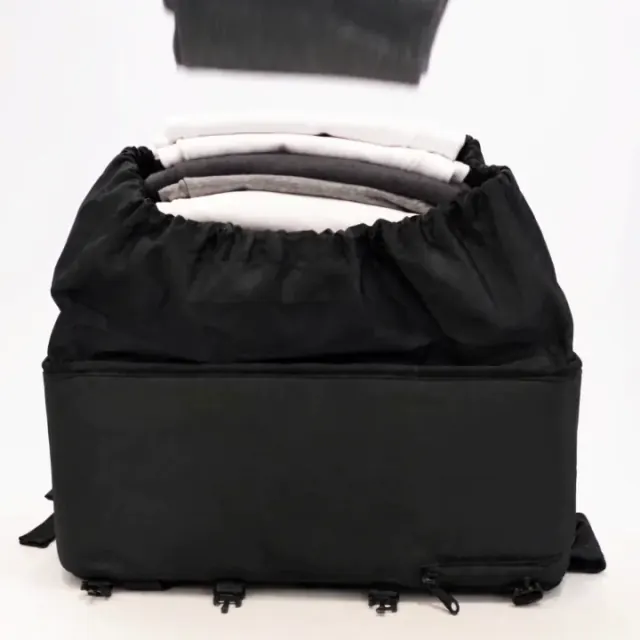
Flick open the metal buckles and lift the lid wide. That’s all the machinery there is — no pump, no vacuum, no power, no batteries. The compression is built into the backpack itself, so it works anywhere, on every trip, with nothing to charge and nothing to break.
The single best trick for flying with hand luggage only is to wear your bulkiest clothes on travel day: worn clothing is generally not counted as airline baggage — the 2026 consensus across carriers — which makes your body the one packing surface no sizer ever measures. Jeans, boots, the light knit: on you, not in the bag. (The airline-by-airline caveats live in our does-a-jacket-count-as-hand-luggage guide.)
The Packing Jacket takes the same idea further. Its lining hides rows of horizontal tube-shaped pockets: roll each garment into a tight tube, slide it into a channel, and a full spare outfit rides flat against your back — no sagging, no bulging, no lumpy-duffel-with-sleeves silhouette. From the outside it reads as a perfectly normal black (or pink) jacket, in six sizes from XS to XXL, rated 4.8 from 387 reviews.
Bonus: the tubes are where your wrinkle-sensitive outfit should travel. Held flat instead of scrunched into a corner of the bag, it arrives almost wrinkle-free. Wear your wardrobe on your shoulders — clothing you wear is clothing.
Your neck pillow is the fifth packing surface: the Compression Neck Pillow's dual-zipper design stores one complete change of clothes and still holds its U-shape the whole flight. Fold the outfit flat into the inner pocket, run the inner zipper all the way around to seal it, then ease the outer compression zipper closed. The pillow puffs up plump and round — exactly what it is: a comfy travel pillow. Rated 4.6 from 266 reviews.
This is not a stuffed laundry sack pretending to be bedding. It keeps its shape, it's genuinely comfortable to sleep on, and it clips onto the backpack's top straps so nothing dangles off your shoulder. Within the five-step plan it's your insurance policy: the fresh landing outfit, the spare for the day something gets rained on, the eighth day you didn't plan for.
A pillow that naps you across Europe and carries an outfit while doing it.
Here is the complete accounting for one week. The backpack (40 × 30 × 20 cm, about 24 litres) takes four tops, one smart shirt, one spare bottom, shorts or a dress, seven sets of underwear and socks, swimwear, spare shoes, sub-100 ml toiletries in the quick-access box, and a 14–15-inch laptop in the padded sleeve — roughly 95% of laptops fit. The jacket's tube pockets take the wrinkle-sensitive spare outfit. The pillow takes one full change of clothes. And the bulkiest outfit — jeans, knit, proper shoes — is on your body, where no sizer looks.
Weight is a non-issue on this plan. A compressed week of clothing plus a laptop stays comfortably light; Ryanair's free bag has no published weight limit as of July 2026, and easyJet's 15 kg cap is a distant ceiling.
Final assembly: pillow and jacket clip onto the backpack's top straps until you need them, so the whole week moves as one compact unit — hands free from front door to hotel door.
One bag travel works better in Europe than anywhere else because the 40x30x20 personal item is free on every major budget carrier — which turns the whole continent into a week-long-trip playground with zero baggage fees in either direction. No bag-drop queue on the way out, no carousel roulette on the way in, and no overhead-bin scramble in between: your bag goes under the seat in front, with your passport, liquids and powerbank one zip away for the entire flight.
It also changes how you move once you land. A 24-litre backpack walks straight onto metros, fits budget-bus luggage rules, and never makes you the person blocking a Lisbon tram with a wheeled suitcase. Multi-city trips stop being a logistics problem and start being an itinerary.
The kit that makes it comfortable is three pieces: the Compression Backpack, the Packing Jacket, and the Compression Neck Pillow. Add all three to your cart and the pillow's price is deducted automatically at checkout — and bundle orders ship free.
Backpack, jacket, pillow — two colours each. Add all three and the pillow's price is deducted automatically at checkout, with free shipping on bundle orders.
The Travel Essentials Kit page skips the how-to and gets straight to the three-piece deal: add the backpack, jacket and pillow, and the pillow is free.
See the Travel Essentials KitThe short, quotable answers to everything this guide covers.
Pack a week in a personal item by combining four moves: a mix-and-match capsule wardrobe of about twelve garments, hard compression inside a 40x30x20 bag, wearing your bulkiest outfit on travel day (a packing jacket carries a spare outfit flat in its lining), and stashing one change of clothes inside a storage neck pillow. A 40x30x20 bag holds roughly 24 litres, which covers seven days once compressed. That exact size flies free on Ryanair, Wizz Air, Vueling and Transavia as of July 2026.
A 40x30x20 bag holds roughly 24 litres — with compression, that's about a week of mix-and-match clothing plus a 14–15-inch laptop. In practice: four to five tops, two bottoms, seven sets of underwear and socks, swimwear, spare shoes and sub-100 ml toiletries. The Ryanwear Compression Backpack is built to that exact published size, with a padded sleeve that fits roughly 95% of laptops.
Roll for volume, keep the wrinkle-sensitive outfit flat: rolling packs tighter in the main bag, while the one outfit you can't afford to crease should travel in the jacket's horizontal tube pockets, where it arrives almost wrinkle-free. In a hardshell compression backpack you can also simply lay clothes in flat — pressed between the two shells, they come out exactly the way they went in.
Compression bags report the biggest savings — up to 60% in published packing-gear comparisons — versus 30–40% for vacuum-pump systems and around 30% for double-zip packing cubes. The catch is that bags, cubes and pumps are extra items you then have to pack. Built-in hardshell compression avoids carrying any of them; our own measured, photographed hardshell test is being added to this page.
Yes — worn clothing is generally not counted as airline baggage (the 2026 consensus across carriers), which is why it's the single most repeated tip in packing guides. Wearing jeans, proper shoes and a knit on travel day frees several litres inside the bag. A packing jacket takes it further by carrying a full spare outfit flat in its lining while looking like completely normal outerwear.
The 40x30x20 plan works on Ryanair, Wizz Air, Vueling and Transavia, which all publish 40x30x20 cm as their free personal item as of July 2026. easyJet allows a larger 45x36x20 cm bag (up to 15 kg), so the same setup fits there with room to spare. The live airline table on this page tracks current free-bag allowances for Europe and the USA, linked to each carrier's own baggage page.
Backpack, jacket, pillow: the three surfaces that turn a 40x30x20 allowance into a full week away. Add all three to your cart and the pillow's price disappears automatically at checkout — with free shipping on bundle orders.
We use strictly necessary cookies to make this site work (e.g. your shopping cart and security). With your consent we may also use analytics and marketing cookies. You can accept all, reject non-essential cookies, or choose what to allow. Read our Cookie Policy and Privacy Policy.
€99.99
Free shipping across the EU
€79.99
Free shipping across the EU
€29.99
Free shipping across the EU