
Compression Backpack
€99.99
Color: Black
1
Free shipping across the EU
How to avoid Ryanair baggage fees, in one sentence: travel entirely inside the free allowance — one 40 × 30 × 20 cm personal bag under the seat, no weight limit (rules as of July 2026). Everything outside that bag is where the fees live. This playbook gives you the real 2026 fee figures, four legal tactics that keep a whole trip inside the free bag, and the three pieces of gear we designed around exactly that allowance. No loopholes, no gate arguments — just the free bag, used properly.
Compression Backpack
€99.99
Free shipping across the EU
You avoid Ryanair baggage fees by travelling entirely inside the free allowance: one personal bag of 40 × 30 × 20 cm that fits under the seat in front of you, with no weight limit (rules as of July 2026). Everything outside that bag is where the fees live — priority boarding, checked luggage, and the gate charges that ambush people who guessed wrong.
The good news is the free bag is bigger than most people remember. Ryanair enlarged it from 40 × 20 × 25 cm in summer 2025, and the current size works out to a genuinely usable 24 litres — enough that we built our whole product line around it. Four legal tactics cover almost every trip: carry a compression bag whose shell is exactly the published size, wear your bulkiest outfit on travel day, use dual-use accessories that carry clothes without counting as luggage, and if a trip truly needs more, add a bag online at booking rather than at the airport.
Notice what's missing: nothing here involves hoping a gate agent is distracted. The whole point is to make the free allowance do the work, so there is nothing to argue about at the gate — and nothing to pay for.
Which?'s December 2025 research put the average price actually paid for a Ryanair cabin bag at £20.50 — and found the advertised £5.99 headline price available less than 1% of the time. Wizz Air came out even pricier at £28.93 on average. Those are the numbers to plan around, not the teaser rates on the booking screen.
Prices also climb the later you decide. A cabin or checked bag added during the original booking is consistently the cheapest version of itself; the same bag added later online costs more, at the airport more again, and at the gate the most of all. That is tactic four in one sentence: if a trip genuinely needs more than the free 40 × 30 × 20 bag, decide at booking and pay the lowest rate you will ever be offered for it.
The same pattern holds if you want to avoid baggage fees on budget airlines generally — budget airlines price paid bags dynamically, and the airport counter is consistently the most expensive place to buy one. The fee system punishes improvisation and rewards the traveller who either fits the free bag or commits early.
If your bag doesn't fit the sizer, Ryanair's oversized bag fee is roughly £70–75 — about €75 — charged on the spot at the gate. It is the single most expensive way to get luggage onto a plane, and it's the fee this entire page exists to keep you away from.
Enforcement is not casual. Gate staff have long been paid a bonus per intercepted oversized bag, and in November 2025 Ryanair raised it to €2.50 per bag and removed the cap. The person looking at your backpack has a direct financial incentive to measure it — so 'oversize and hope' is not a tactic, it's a donation.
The classic failure mode is a soft bag that bulged: it measured fine on your bed, but a week of clothes pushed every panel a few centimetres proud by the time you reached the queue. The fix is structural, not optimistic. A bag whose rigid shell holds the published 40 × 30 × 20 cm once it's compressed and buckled takes the guesswork out — what you measured at home is what arrives at the sizer, however much you packed inside it.
Every tactic on this page is legal, repeatable and mapped to a piece of gear we built for it. No loopholes that expire next season — just the free allowance, used to the last cubic centimetre.
Compression does the packing, the hardshell does the compliance. Overfill past the rim, cinch the drawstrings, lean in and click the metal buckles — the shell settles at the published 40 × 30 × 20 cm. No pump, no battery, nothing to charge, and a padded slot for a 14–15″ laptop.
Worn clothing generally isn't counted as luggage, so your bulkiest outfit should fly on your body. The Packing Jacket goes further: horizontal tube pockets hold a full extra outfit flat — no sag, no bulge. It reads as a normal jacket because it is one.
A neck pillow around your neck is a neck pillow, whatever's inside it. Ours has a dual-zipper design that stores a full change of clothes and still holds its U-shape the whole flight — recognised at the gate, roomy on the inside, and genuinely comfortable to sleep on.
When a trip genuinely needs more than the free bag, buy the extra bag with your original booking — that's the cheapest it will ever be. Every step later costs more, and the gate is the most expensive counter in the airport at roughly €75 per oversized bag.
Yes, it saves you cash. Packs up to 3x more than regular backpacks. But honestly? It’s just a ridiculously good backpack.
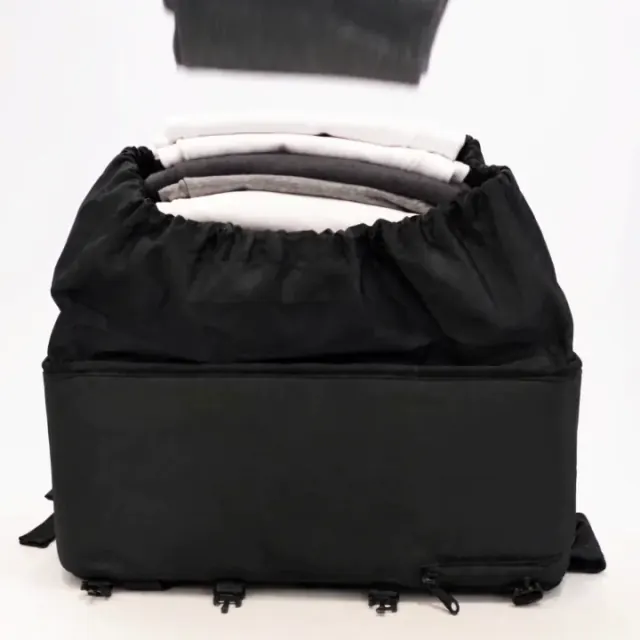
Flick open the metal buckles and lift the lid wide. That’s all the machinery there is — no pump, no vacuum, no power, no batteries. The compression is built into the backpack itself, so it works anywhere, on every trip, with nothing to charge and nothing to break.
The tactic outlives one airline: Ryanair, Wizz Air, Vueling, Volotea and TUI fly all publish 40 × 30 × 20 cm as the free personal item, and easyJet's 45 × 36 × 20 allowance swallows it with room to spare. Check your carrier against its own published free allowance — in cm or inches.
| Airline | Free item · max | Fits | ||
|---|---|---|---|---|
| easyJet | 45× | 36× | 20 | Your backpack fits this airline's free item |
| Eurowings | 40× | 30× | 25 | Your backpack fits this airline's free item |
| Ryanair | 40× | 30× | 20 | Your backpack fits this airline's free item |
| TUI fly | 40× | 30× | 20 | Your backpack fits this airline's free item |
| Volotea | 40× | 30× | 20 | Your backpack fits this airline's free item |
| Vueling | 40× | 30× | 20 | Your backpack fits this airline's free item |
| Wizz Air | 40× | 30× | 20 | Your backpack fits this airline's free item |
Not responsible for airline changes. Verify before you fly.
Compression is the packing hack with the best measured record: independent tests report compression bags reclaiming up to 60% of packing volume, vacuum systems 30–40%, and packing cubes around 30%. Rolling clothes instead of folding, and wearing your bulkiest items on travel day, add a further margin that costs nothing at all.
But there's a catch nobody selling vacuum bags mentions: saved volume only saves money if the bag it lives in still passes the sizer. Compress a week of clothes into a soft duffel and it bulges straight back over the line while you queue. That's why we built the compression into the bag itself — two hardshell halves you press together by hand and lock with metal buckles, so the compressed result is the bag, at the published 40 × 30 × 20 cm. No pump to charge, no vacuum to die mid-trip, nothing extra to pack afterwards.
Rolling into tubes is the second hack worth adopting, and it's the whole trick behind the Packing Jacket: a garment rolled into a tight tube slides into a horizontal channel and holds its shape, so a fully loaded jacket hangs flat. For the complete method, our week-in-a-personal-item guide walks the packing list step by step.
Yes — worn clothing generally isn't counted or weighed as baggage, and that has held as the consensus across European budget airlines into 2026. One worn outfit is unremarkable: a worn jacket isn't a bag, so there's nothing for the sizer to measure.
The Packing Jacket is that idea taken seriously. Its lining hides rows of horizontal tube pockets that hold a rolled full outfit — flat, evenly spread, none of the duffel-bag bulges that square pockets produce — while the outside stays ordinary black outerwear in six sizes, XS to XXL. The Compression Neck Pillow plays the same role at the other end: a dual-zipper pillow that stores a change of clothes and still reads at the gate as exactly what it is, a pillow.
One honest caveat: extreme layering has occasionally been penalised — the extreme-layering stunts that make the news got there precisely because airlines pushed back. One worn outfit plus a smart jacket sits comfortably inside normal behaviour; a walking laundry pile does not. Our jacket hand-luggage guide covers the airline-by-airline detail.
Yes, and the maths turns quickly: the complete three-piece kit — compression backpack, packing jacket and storage neck pillow — costs less than three oversized-bag gate fees at Ryanair's roughly €75 rate. Put differently, at Which?'s measured average of £20.50 per paid Ryanair cabin bag, around ten flights with a paid bag cost more than the entire kit — and the kit is still there for every trip after that.
The bundle makes it simpler still: add all three to the cart and the neck pillow's price is deducted automatically at checkout, with free shipping on bundle orders. Prices display in your own currency on every page, so what you see is exactly what you pay.
And unlike a fee, the gear leaves something behind — 4.8 out of 5 across 1,330 reviews sitewide says it holds up. A bag fee buys one flight's forgiveness. The kit buys a system: the free allowance maxed out by the backpack, your bulkiest clothes worn in the jacket, a spare outfit riding in the pillow, and nothing left over for the gate to charge you for.
The airline-by-airline answers for 2026: what worn clothing counts as, where the caveats start, and how far a packed jacket can reasonably go.
Read the jacket rulesAll three tactics' gear in one order: add the backpack, the jacket and the neck pillow, and the pillow's price is deducted automatically at checkout — with free shipping on bundle orders. Prices show in your currency.
Short, quotable answers to the questions travellers actually ask — figures current as of July 2026.
Travel entirely inside Ryanair's free personal bag allowance: 40 × 30 × 20 cm, stowed under the seat, with no weight limit (as of July 2026). Use a right-sized compression bag, wear your bulkiest outfit on travel day, and put dual-use accessories like a storage neck pillow to work. If a trip genuinely needs an extra bag, book it online with your original booking — never at the gate.
Which? found in December 2025 that the average price actually paid for a Ryanair cabin bag was £20.50, while Wizz Air's average was £28.93. The advertised £5.99 Ryanair price was available less than 1% of the time. Budget for the average, not the headline.
Roughly £70–75 (about €75), charged at the gate if your bag doesn't fit the sizer. That is far more than adding a bag online in advance, which is why gambling on an oversized bag is the most expensive mistake in budget flying.
No — worn clothing generally isn't counted or weighed as baggage, per the 2026 consensus across European budget airlines. One worn outfit, a packing jacket and a neck pillow around your neck are all fine. Extreme layering stunts have occasionally been penalised, so keep it to what you'd plausibly wear.
Yes — independent tests report compression bags reclaim up to 60% of packing volume, vacuum systems 30–40%, and packing cubes around 30%. The catch is that compressed clothes still need a bag that passes the sizer, which is why our backpack's buckled hardshell holds the exact published 40 × 30 × 20 cm.
Ryanair enforces hardest: gate sizers backed by a per-intercepted-bag staff bonus that was raised to €2.50, uncapped, in November 2025. Wizz Air is pricier when you do pay — its average paid cabin-bag price was £28.93 in Which?'s December 2025 research, versus Ryanair's £20.50.
Three pieces built around the free 40 × 30 × 20 allowance: a compression backpack whose shell holds the published size, a jacket that wears a whole outfit, and a pillow that carries another. Add all three and the pillow's price disappears at checkout.
We use strictly necessary cookies to make this site work (e.g. your shopping cart and security). With your consent we may also use analytics and marketing cookies. You can accept all, reject non-essential cookies, or choose what to allow. Read our Cookie Policy and Privacy Policy.
€99.99
Free shipping across the EU
€79.99
Free shipping across the EU
€29.99
Free shipping across the EU